Pharma AI: what 21 CFR Part 11 compliance actually means for your model pipeline
Pharma AI compliance under 21 CFR Part 11 means audit trails, validated electronic records, and governed model pipelines. Practical productionisation, not a legal memo

9
min read

In regulated pharmaceutical manufacturing, AI pipelines need audit trails, validation evidence, controlled records, model governance, and compliance-ready production architecture. The model is the easy part. The system around it is what takes the work.
Note: this article offers a practical technology and AI productionisation perspective for pharma manufacturing teams. It is not legal or regulatory advice. Compliance decisions should be made with qualified regulatory and quality professionals.
In our experience working with pharmaceutical manufacturers, AI conversations in this sector almost always reach the same point. The data science team has built something promising. The operations team is interested. The business case is real, particularly in API manufacturing, formulation, and quality control, where the cost of a rejected batch is significant and the regulatory consequence of a quality failure is immediate. And then someone asks the question that decides whether the project becomes a pilot or a production system: how is this going to be validated, audited, and inspected?

That question is not solved by accuracy. It is solved by the architecture around the model. In a GMP-controlled manufacturing environment, electronic records, electronic signatures, audit trails, validation evidence, change control, and access governance are not optional. They are conditions for the system to be considered usable in the production of a regulated medicine. An AI pipeline that does not respect this reality from the start may produce strong proofs of concept, but it will struggle to move into the operating environment where the value actually lives.
Week 13 of this series explained how chemicals batch manufacturing changes the AI pipeline. This week, we move to pharma manufacturing, and to the most consequential difference: the AI pipeline itself becomes part of a controlled system. The framework does not change. The conditions it has to meet do.
|
What 21 CFR Part 11 means in practical terms
A practitioner's translation, not a regulatory one
US FDA's 21 CFR Part 11 governs electronic records and electronic signatures used in place of paper records and handwritten signatures in regulated environments. The regulation is widely cited and frequently misunderstood. At a practical level, and for the purpose of an AI productionisation conversation, the implications come down to a small number of operating requirements. The systems and records used in regulated decisions must be controlled. Records must be attributable, legible, contemporaneous, original, and accurate. Access must be governed. Changes must be tracked. Signatures, where applied, must be linked unambiguously to the record they approve. And the evidence that the system does all of this must be available for inspection.
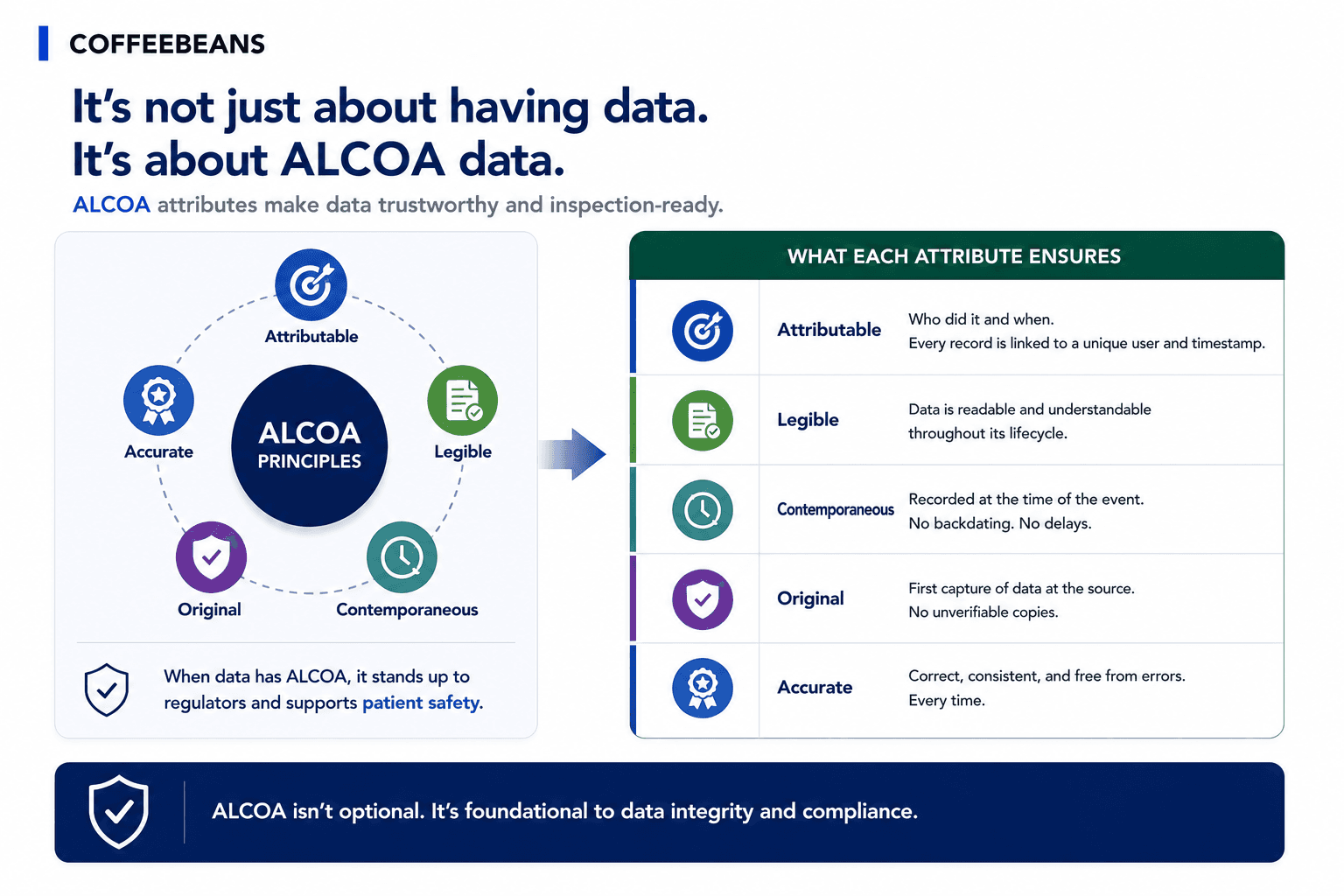
For an AI model pipeline that supports or influences a regulated manufacturing decision, the implication is direct. Source data is a controlled record. Feature definitions and training datasets are controlled records. Model versions, validation evidence, deployment approvals, and monitoring outputs are controlled records. The audit trail that links a model prediction back to the inputs and the version that produced it is not a documentation overhead. It is part of the system the regulator may inspect.
The audit trail is not paperwork. It is part of the production architecture, and it has to be designed into the pipeline from the beginning.
Why pharma AI pipelines are structurally different
The infrastructure is already there. The discipline that goes with it has to come along.
There is a structural advantage in pharma AI that is often missed in the regulatory conversation. GMP compliance has already mandated validated electronic systems across pharmaceutical manufacturing. Manufacturing execution systems, laboratory information management systems, quality management systems, and SCADA are not pilots or aspirations. In well-run pharma operations, they are live, generating data continuously, and already operating under audit trail and electronic record discipline. The AI conversation is therefore not about building infrastructure. It is about layering AI on top of infrastructure that compliance has already forced the organisation to build.
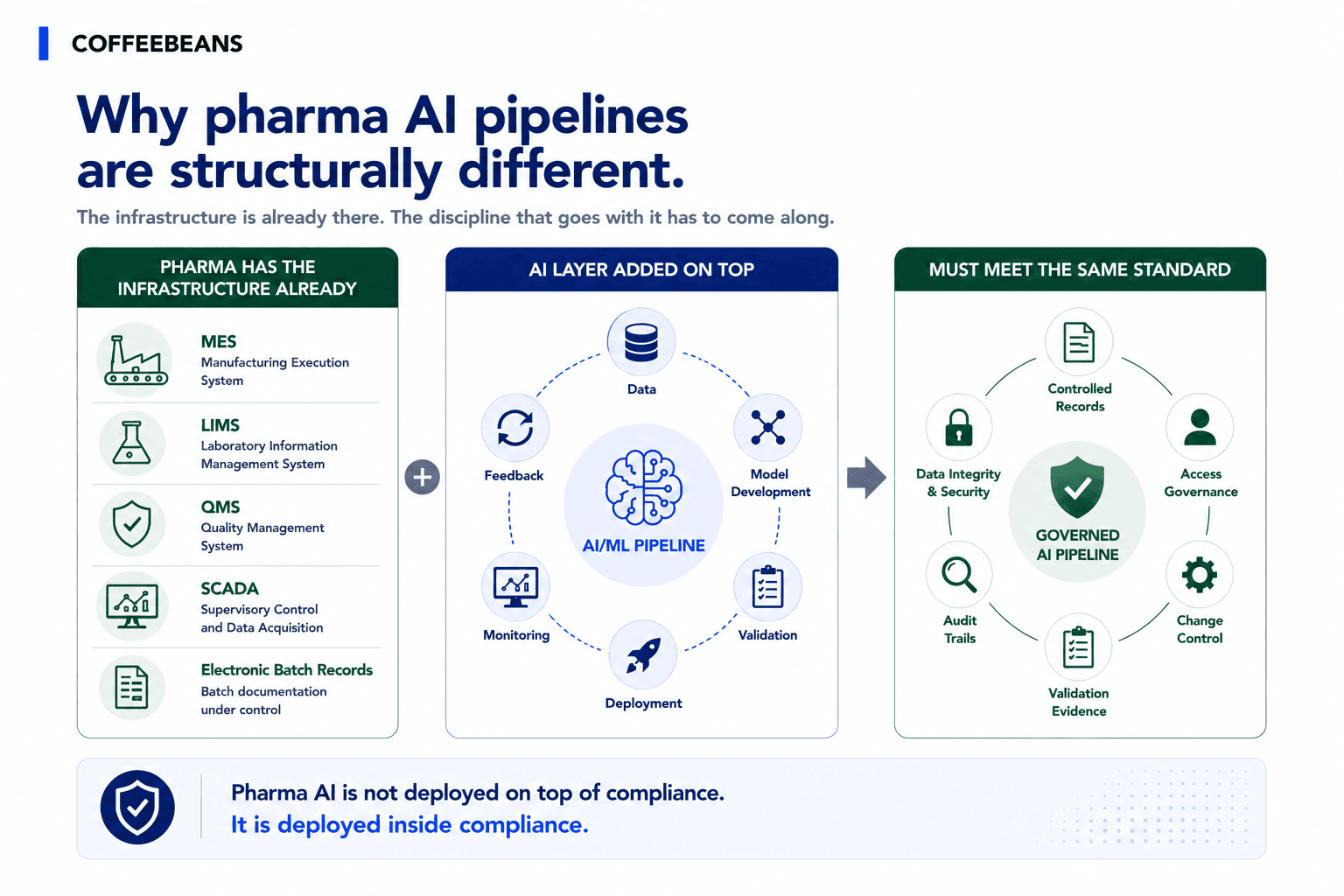
The catch is that the AI layer must operate to the same standard as the systems it sits on. Pharma AI use cases routinely influence or support workflows that are themselves controlled: batch quality review, deviation investigation, CAPA workflows, batch release support, predictive maintenance in GMP environments, manufacturing exception detection, supply chain quality decisions, regulatory documentation review, and pharmacovigilance signal review. Each of these workflows is regulated. Each of them generates controlled records. An AI model that supports any of them inherits the same control requirements.
|
What auditability means for an AI model pipeline
Reconstructability is the operational test
The most useful operating definition of auditability in pharma AI is reconstructability. If, six months after a model has supported a regulated decision, the team is asked to explain how the decision was reached, can the full chain be reconstructed? Source data, data cleaning, feature definitions, training and validation datasets, model version, experiment history, approval workflow, electronic signatures where applied, deployment version, model output, human review action, and any subsequent monitoring or retraining events
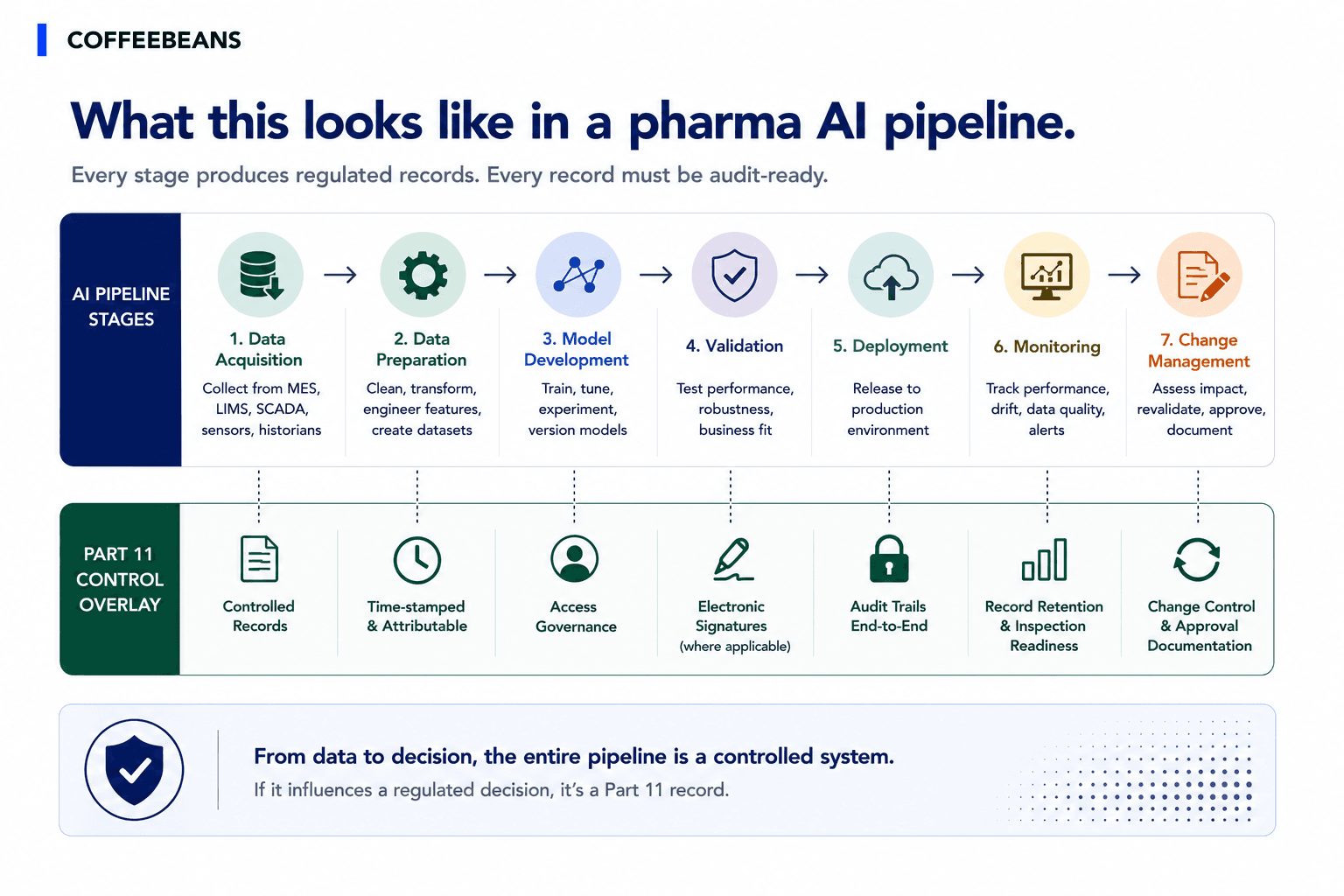
If the answer is yes, the pipeline is functioning as a controlled system. If the answer is no, the system may still produce useful outputs, but it is not yet ready for the regulated environment it is operating in. In our experience, the gap is rarely in the model itself. It is in the discipline around the pipeline. Feature definitions live in notebook code that has changed several times. The dataset version that produced the deployed model cannot be recovered. The approval that promoted the model into production was given by email rather than through a controlled workflow. None of these issues affect model performance. All of them affect inspection readiness.
A model that cannot be traced, validated, and governed will struggle to move into production, regardless of how accurate it is.
Validation documentation is created throughout the lifecycle, not at the end
Computer system validation principles applied to ML pipelines
The most expensive shortcut in pharma AI projects is to treat validation documentation as a closing step. The reality is the opposite. Validation evidence is created at every stage of the AI productionisation chain, and it can only be created at the time the work is done. Requirements definition, risk assessment, data validation, model validation, test cases, human review gates, change control, deployment approval, monitoring documentation, and retraining governance each generate evidence at the moment the activity occurs. Trying to reconstruct that evidence afterward is consistently more expensive than creating it as the project progresses, and is often impossible.
Validated AI pharmaceutical manufacturing practice borrows directly from computer system validation discipline. Each stage of the AI pipeline produces its own validation deliverables. Stage 01 (data readiness) produces lineage, access control, and data integrity evidence. Stage 02 (signal creation) produces controlled feature definitions and transformation documentation. Stage 03 (model building) produces tracked experiments and a model registry record. Stage 04 (pre-production sign-off) produces the validation report, risk assessment, and approval workflow. Stage 05 (deployment) produces change control records, access controls, and rollback procedures. Stage 06 (model health) produces monitoring records and retraining governance. Together, these are not separate documentation tasks. They are the natural output of running the productionisation process under the discipline a regulated environment requires.
Model risk management determines the depth of control
Not every pharma AI use case carries the same regulatory weight
Model risk management is one of the more practical concepts to bring into the pharma AI conversation. Not every model in a pharma environment requires the same depth of validation, human review, or change control. The depth of control should be calibrated to the risk the model carries, defined by how directly it influences a regulated decision and the consequence of being wrong.
Lower-risk use case example | Higher-risk use case example |
A model summarising internal SOPs for a manufacturing team | A model influencing batch release or quality investigation |
A regulatory document drafting assistant in advisory mode | A model supporting deviation classification or CAPA decisions |
A predictive maintenance model on non-GxP equipment | A predictive maintenance model on GxP-impacting equipment |
An OEE dashboard recommendation model in advisory mode | A model flagging potential product quality deviation |
Lower validation depth, lighter human review | Higher validation depth, structured human review gates |
In our experience, the most common error in pharma AI is to apply the same level of discipline to every use case, which produces either over-validation of low-risk applications (which delays value) or under-validation of high-risk applications (which creates real exposure). Risk-based control is the operating answer, and it requires the risk assessment to be explicit and documented, not implicit.
|
The six-stage framework, adapted for pharma
Same framework, validated implementation
The CoffeeBeans AI Productionization Value Chain applies to pharma in the same structural way it applies to mining and chemicals. What changes is the discipline at each stage. The table below summarises the adaptation.
Stage | What it requires in regulated pharma manufacturing |
Stage 01: Data Readiness and Trust | Source data lineage, access control, and data integrity must be governed across MES, LIMS, QMS, SCADA, and electronic batch records. Inputs to the model are controlled records, not informal extracts. |
Stage 02: Signal Creation and Data Prep | Feature definitions, transformations, and preprocessing are documented, version-controlled, and reproducible. The pipeline itself becomes part of the validated system. |
Stage 03: Model Building and Experimentation | Experiments, datasets, parameters, and model versions are tracked with the rigour required for inspection. The model registry is treated as a controlled record store. |
Stage 04: Pre-Production Sign-off | Validation evidence, risk assessment, and human review gates align with computer system validation principles. Approval workflows include quality and compliance leadership. |
Stage 05: Model Deployment and Serving | Deployment follows change control. Access controls and electronic signatures are managed where applicable. Rollback paths and audit trails are part of the release design. |
Stage 06: Model Health and Performance | Monitoring, drift detection, retraining triggers, and review cycles are documented as part of the controlled system. Retraining itself moves through change control. |
In pharma manufacturing, AI investment intensity is concentrated where the regulatory consequences are also highest: API manufacturing, formulation manufacturing, and quality control and GMP compliance. These are the stages where validated electronic records, audit trails, and change control already operate, and where AI naturally sits on top of an existing controlled environment. The structural advantage is real. The structural condition is that the AI layer must operate to the same standard.
The leadership mistake we see repeatedly
Asking 'is the model accurate?' when the operating question is something else
The most common leadership question in pharma AI is, is the model accurate enough? In a regulated manufacturing context, accuracy is necessary but not sufficient. A more useful executive framing is different.
Can the model pipeline be validated, audited, controlled, and trusted in a regulated manufacturing environment? If the answer is yes, the AI capability is positioned to deliver value across batch quality, OEE, deviation management, predictive maintenance, and the rest of the commercial chain. If the answer is no, the model may perform well in evaluation and stall on the way to production, regardless of how strong its accuracy looks.
How CoffeeBeans helps
Building validation-ready AI pipelines for regulated pharma manufacturing
CoffeeBeans works with pharmaceutical manufacturers to build pharma AI compliance discipline into the productionisation chain from the start. Our engagements typically begin with a risk-based framing of the AI use cases the organisation is pursuing: which models support regulated decisions, what level of validation is appropriate to each, where human review gates belong, and how the AI layer connects to the existing MES, LIMS, QMS, and SCADA controlled systems.
From that foundation, we operationalise 21 CFR Part 11 machine learning practice across the value chain: data lineage and access control in Stage 01; controlled, versioned feature definitions in Stage 02; tracked experiments and a model registry treated as a controlled record store in Stage 03; structured pre-production validation with quality and compliance review in Stage 04; deployment under change control with access governance and rollback in Stage 05; and documented monitoring, drift detection, and retraining governance in Stage 06. The objective of validated AI pharmaceutical manufacturing is straightforward: the AI capability should deliver measurable value in batch quality, deviation reduction, OEE, predictive maintenance, and the other commercial-engine outcomes, while remaining inspection-ready throughout its operational life.
Can your AI pipeline be inspected, not just demonstrated?
If your pharma manufacturing operation has AI initiatives that perform well in proof of concept but struggle to reach validated production, the gap is almost always in the pipeline discipline around the model. CoffeeBeans can help your team build pharma AI compliance into the productionisation chain from Stage 01, operationalise 21 CFR Part 11 machine learning practice, and design validated AI pharmaceutical manufacturing infrastructure that holds up under inspection. Talk to our Enterprise AI practice about compliance-ready AI in your operation.
Like What You’re Reading?
Subscribe to our newsletter to get the latest strategies, trends, and expert perspectives.
Similar Reads


Links
Subscribe
Newsletter
Sign up to learn about AI in the business world.
© 2026 CoffeeBeans. All Rights Reserved.