Your model was accurate when you built it. That was nine months ago.
Model monitoring enterprise AI discipline keeps production AI reliable after launch. Track input data, features, predictions, and business outcomes to sustain trust

9
min read

A model that performed well at launch may be unreliable today. Input data, operating conditions, equipment behaviour, and business processes all change. Model health and performance must be monitored continuously, not assumed.
There is a sentence we hear in industrial AI programme reviews more often than any other. The model was accurate when we deployed it. The statement is usually true. It is also, on its own, insufficient. Accuracy at launch describes a moment in time. It does not describe what happens to a model after operating conditions evolve, sensors age, ore characteristics shift, maintenance regimes change, and data pipelines quietly drift over the months that follow.
In our experience working with mining and industrial organisations, this is where the most expensive form of production AI failure tends to occur. Not at deployment, but in the months after deployment. The model is still running. The dashboards are still populated. Predictions are still flowing. Nobody is sure whether they should still be trusted, because nobody is monitoring the things that would tell them.

Week 10 explained how to deploy models with the release control, rollback, and canary discipline that production AI requires. Week 11 explains the next layer: how to monitor the model after it is live, so that performance issues are detected, diagnosed, and addressed before operational trust has eroded. Stage 06 of the CoffeeBeans AI Productionization Value Chain, Model Health and Performance, is where industrial AI either remains a managed capability or quietly decays into a one-time project that the operations team has stopped relying on.
|
Why accuracy at launch is not enough
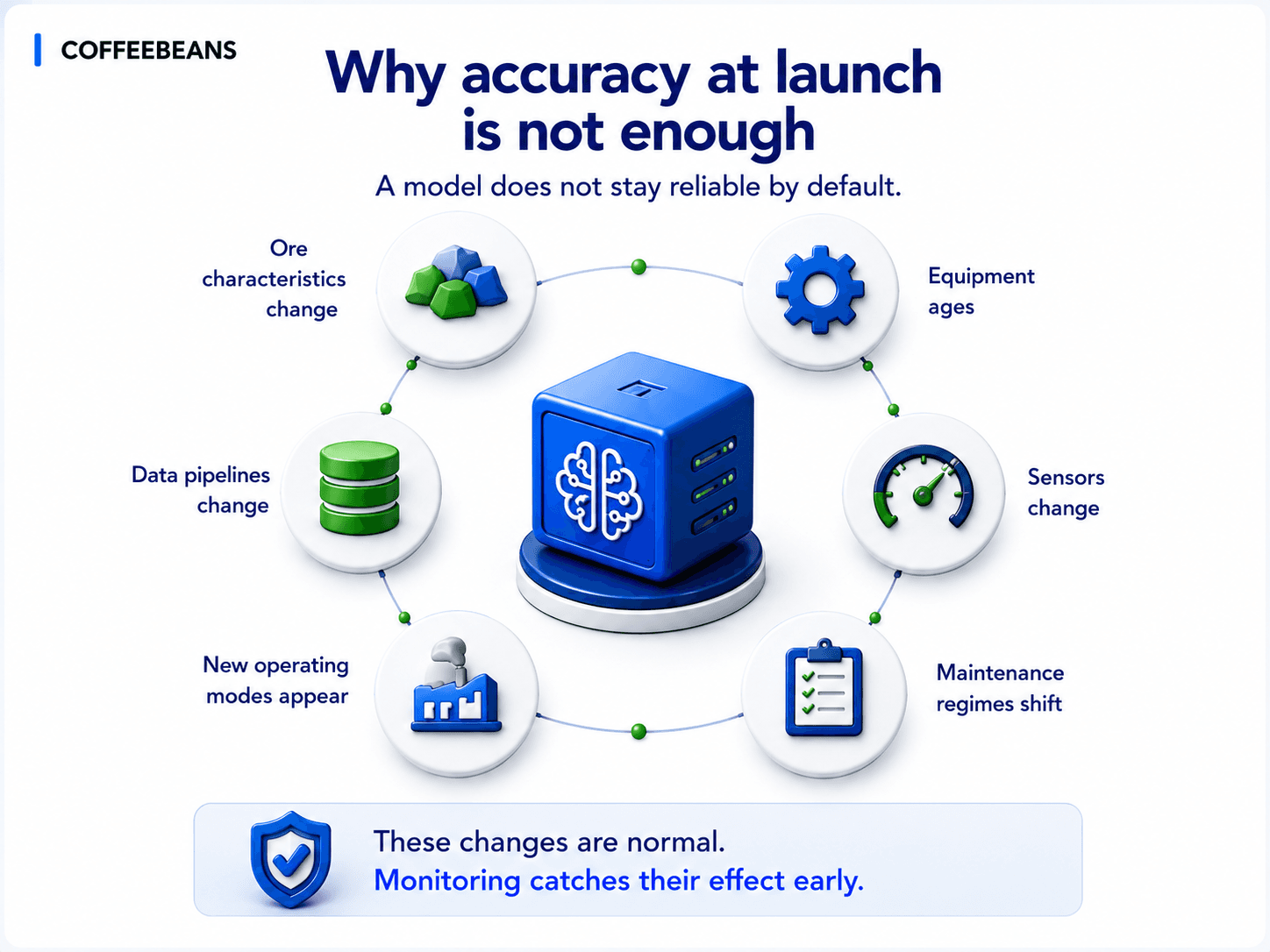
A model does not stay reliable by default
The accuracy a model reports at launch is based on historical data, controlled testing, and pre-production validation. Each of these is a snapshot. None of them remains valid indefinitely. Once the model is live, it encounters the working reality of a plant or mine that is constantly in motion. In our experience, the conditions that erode model performance after deployment include all of the following:
Ore characteristics change. The mineralogical profile feeding the plant shifts as the ore body is worked through. The model trained on one operating envelope encounters another.
Equipment ages. A SAG mill, a crusher, or a conveyor behaves differently at 18 months of operation than at the time the training data was collected. Wear profiles, vibration signatures, and power draw patterns all evolve.
Sensors change. Instruments are replaced, recalibrated, or moved. A vibration sensor reinstalled two metres away from its original position reports the same parameter but a different signal.
Maintenance regimes shift. The maintenance team revises intervention schedules, introduces new protocols, or changes how events are logged. The labels the model trained against no longer reflect how reality is now being recorded.
New operating modes appear. The plant introduces a new production target, a new ore blend, or a new operating cycle. The model has no training data for any of it.
Data pipelines change. An upstream system is upgraded, a tag is renamed, a feature pipeline is modified. The model continues to produce predictions on inputs that no longer mean what they used to.
Each of these is normal. None of them is a failure of the AI programme. All of them affect model behaviour. The discipline that catches the effect before it affects operations is monitoring, and only monitoring.
Accuracy at launch is a starting condition, not an ongoing guarantee. The model does not stay reliable by default. It stays reliable because it is managed.
The four areas a model health programme must cover
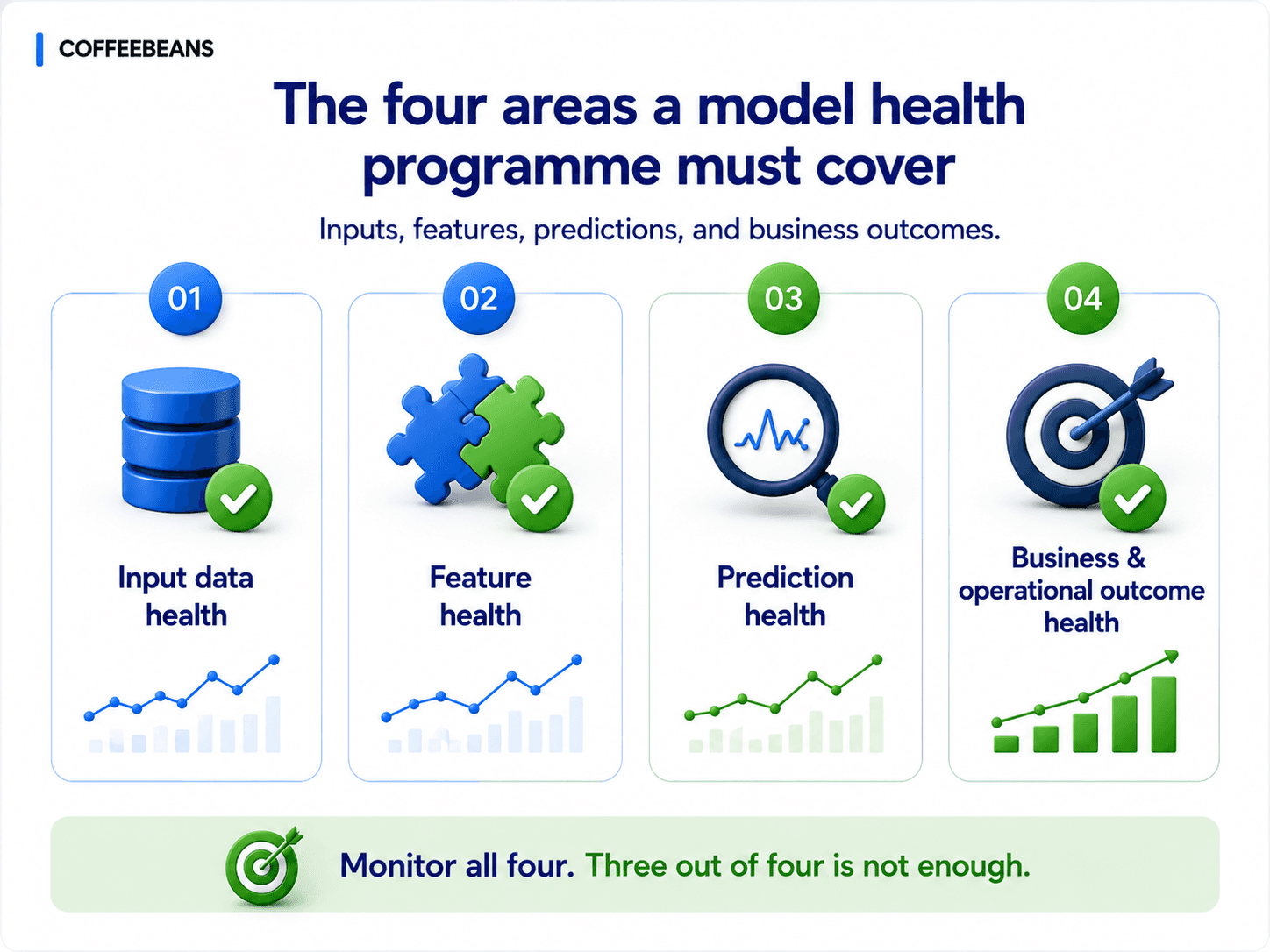
Inputs, features, predictions, and business outcomes
Effective model monitoring enterprise AI discipline rests on four monitoring areas. Each one answers a different question. Each one is necessary. None of them is sufficient alone.
# | Monitoring area | What it must answer |
1 | Input data health | Is fresh, complete, timely, and valid data reaching the model? Are sensor feeds updating on schedule, are values within expected ranges, and is data quality stable across shifts and sites? |
2 | Feature health | Are the features the model depends on being generated correctly and consistently? Are time windows holding, are imputation strategies behaving as designed, and is the feature pipeline executing on schedule? |
3 | Prediction health | Are model outputs behaving as expected? Has the alert frequency, confidence distribution, or output range changed in ways that suggest the model is encountering conditions it was not built for? |
4 | Business and operational outcome health | Are the predictions still useful for the decision they were built to support? Are operators acting on the outputs, is the false-alarm burden manageable, and is the model still delivering the operational outcome the business case promised? |
Most enterprise AI deployments cover one or two of these areas at best. Input data is sometimes monitored because the data engineering team owns it. Prediction volume is sometimes monitored because the serving infrastructure surfaces it. Feature health and business outcome health are most often unmonitored, because nobody has been made responsible for them. This is the structural gap that allows a model to remain technically live while operationally stale.
Input data monitoring in mining environments
The model may still produce outputs after the inputs have degraded
Input data monitoring is the most underestimated layer of production AI monitoring. The reason is structural. When input data quality degrades, the model does not usually stop functioning. It continues to produce predictions, on inputs that have quietly become unreliable. In a working mining operation, the failure modes we have seen include:
A sensor feed stops updating after an OT-side configuration change, and the historian tag the model depends on becomes static. The model continues to score using the last valid value.
A vibration reading becomes intermittently missing because the instrument has begun to fail. The imputation logic substitutes a plausible value, and the model produces a plausible but increasingly wrong prediction.
Power draw values arrive several minutes late because of a network change. The model that depended on near-real-time alignment now operates on data that no longer matches the operating moment.
A throughput field changes format after an ERP upgrade. The pipeline parses it incorrectly. The model continues to function on a feature that is now systematically biased.
A historian tag is renamed, and the pipeline silently falls back to a default value because the new name is not recognised.
Maintenance logs are incomplete for several shifts because of an unrelated workflow change. Failure labels available in training are absent in serving.
In each of these cases, the model is still running. The problem is upstream of the model. Without explicit input data monitoring, none of these conditions surfaces until the model output has already become operationally unreliable, and by then trust has begun to erode.
Prediction monitoring and alert thresholds
Watch what the model is doing, not just whether it is doing it
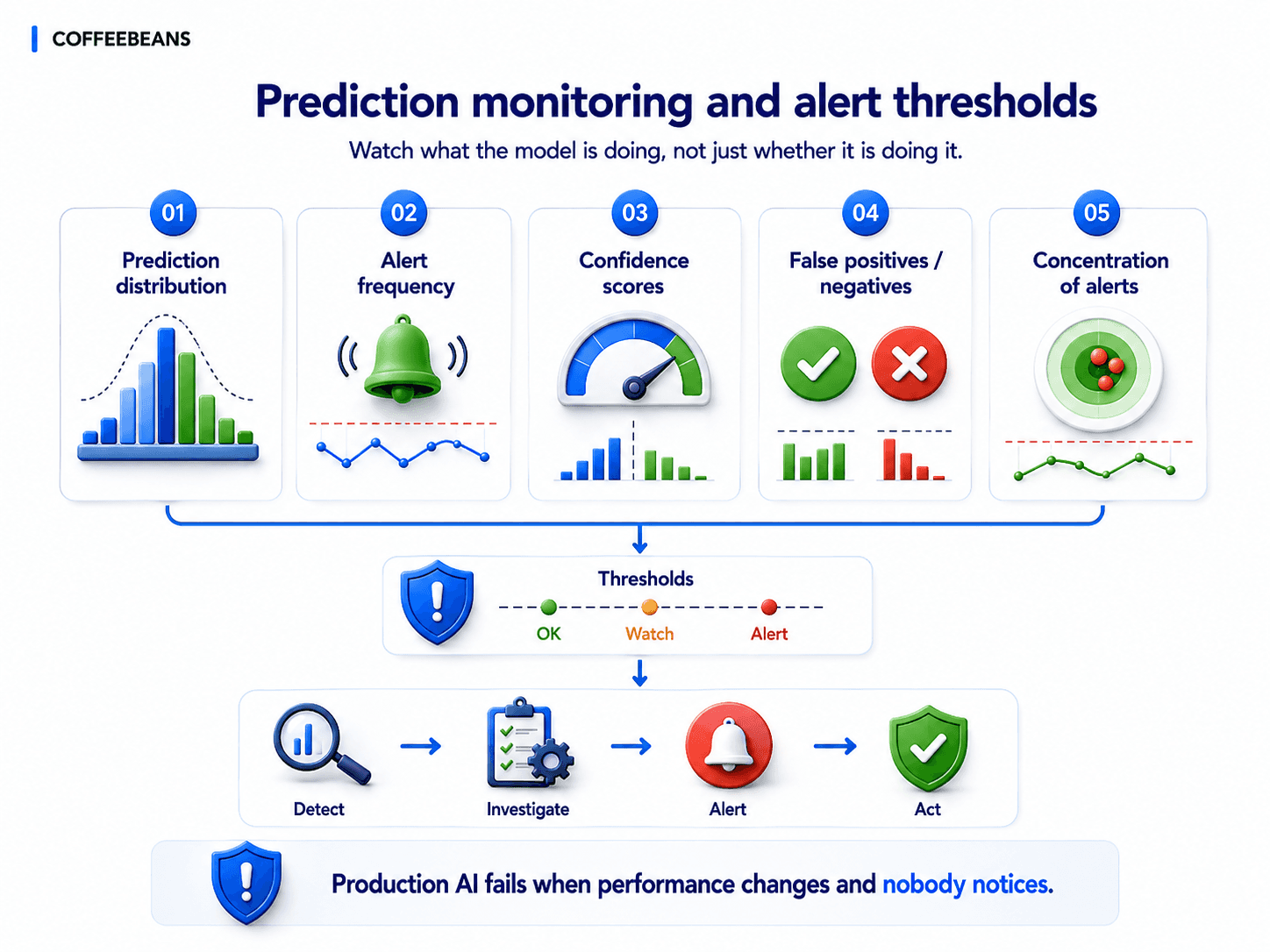
AI model performance tracking requires monitoring the predictions themselves, not only the existence of predictions. The patterns that matter for an industrial AI system include:
Prediction distribution. Has the shape of the model's output changed in ways that suggest input conditions are no longer typical?
Alert frequency. Is the model generating significantly more or fewer alerts than its operational baseline? Either direction can indicate a problem.
Confidence scores. Is model confidence dropping systematically, suggesting the model is operating outside its training distribution?
False positive and false negative signals. When operational feedback is available, are the rates consistent with pre-production expectations?
Sudden changes in output. A step change in average prediction value is rarely random. It almost always indicates an upstream condition.
Concentration of alerts. Are alerts clustering on specific asset classes, shifts, or sites in ways that suggest local conditions have changed, or that the model is generalising poorly to a particular subset?
Alert thresholds are how all of this becomes actionable. A threshold is the rule that defines when the system should notify someone that the model, the data, or the pipeline may be behaving abnormally. Setting thresholds well is a judgement task that involves data science, operations, and reliability engineering working together. Set too tight, and the monitoring system becomes noise. Set too loose, and the system goes silent until something serious has gone wrong.
|
Business outcome monitoring matters more than technical drift
A model is healthy only if it continues to support the decision it was built for
Technical monitoring detects when the model is behaving differently. Business outcome monitoring detects whether the model is still useful. These are not the same question, and in industrial AI, the second one matters more. A model can be technically stable, generating consistent predictions on healthy input data, while delivering progressively less operational value. In our experience, this happens for several recurring reasons. The maintenance team begins to lose confidence in the alert quality. The operating context shifts in a way the model has not adapted to. Operators stop acting on the recommendations. The model continues to work, in the technical sense, while its actual operational impact quietly approaches zero.
Business outcome monitoring for mining AI should include:
Maintenance actionability. Are the alerts the model generates still acted on, or have maintenance teams begun to filter them out?
Downtime impact. Is the model still associated with measurable reductions in unplanned downtime?
False alarm burden. Has the false-alarm rate drifted in ways that erode trust faster than the model can rebuild it?
Operator trust. Are operators continuing to engage with the model's recommendations, or has the system become background noise?
Lead time before intervention. Is the model still providing enough warning for the maintenance team to act, or has the predictive horizon contracted?
Throughput and safety indicators. Where the model influences production or safety decisions, are the underlying outcomes still moving in the expected direction?
A model that is technically healthy and operationally useless is still failing. It is just failing more quietly than a model that has stopped producing outputs.
The leadership mistake we see repeatedly
Asking 'is the model still running?' instead of 'is it still trusted?'
The most common leadership question in the months after an industrial AI deployment is, is the model still running? The technical answer is almost always yes. The model is technically operational, the pipeline is producing predictions, the dashboard is being refreshed. The question that actually determines whether the AI investment is delivering value is different.
Is the model still reliable, still useful, and still trusted by the operation? That question requires evidence from input data monitoring, feature monitoring, prediction monitoring, and business outcome monitoring. It cannot be answered by confirming that the endpoint is responding. It can only be answered when monitoring is structured to detect the conditions that would change the answer.
Monitoring is an operating discipline, not a dashboard
What it takes to keep production AI healthy in practice
Effective monitoring requires more than instrumentation. It requires an operating model. In our experience, the operating model that holds up over time includes the following:
Clear ownership. A named individual or team is responsible for the health of each deployed model and accountable for its monitoring.
Dashboards and alerts that match the cadence of the decision. The reliability team needs different monitoring views from the data science team and from operations. All three should be aligned to a single source of truth.
An escalation process. When a monitoring threshold is crossed, the path from alert to action is documented, not improvised.
Review cadence. Model health is reviewed on a defined schedule (weekly, monthly, or quarterly depending on use case), not only when something appears to have gone wrong.
Feedback loops from operations. The operators and maintenance teams who use the model output have a structured way to flag when alerts have become less useful or when something is no longer behaving correctly.
Retraining criteria. The conditions under which a model will be retrained are defined in advance, including which monitoring signals trigger which response.
Incident documentation. When monitoring catches an issue, the diagnosis, response, and resolution are documented so the next incident benefits from the experience of the last.
|
How Stage 06 closes the productionisation chain
Without monitoring, the previous five stages quietly lose their value
Stage 06 of the CoffeeBeans AI Productionization Value Chain is what turns the previous five stages into a sustained operational capability. Data Readiness and Trust, Signal Creation and Data Prep, Model Building and Experimentation, Pre-Production Sign-off, and Model Deployment and Serving all deliver work that has lasting value only if Stage 06 keeps the deployed system healthy. Without ongoing monitoring, the cumulative investment in the first five stages decays quietly over months. The model that data readiness made possible becomes unreliable. The features the team engineered with rigour drift. The experiments that were tracked carefully become difficult to compare against current behaviour. The pre-production validation becomes irrelevant as operating conditions move beyond what it tested. The deployment infrastructure continues to run, but on a model that is no longer doing what it was deployed to do.
Stage 06 is what prevents this. It is the discipline that keeps the AI capability operating as designed, and the discipline that ensures the organisation knows quickly when redesign is required.
How CoffeeBeans helps
From deployed model to monitored, managed AI capability
CoffeeBeans works with mining and industrial organisations to build model monitoring enterprise AI infrastructure that closes the gap between a technically deployed model and an operationally managed AI capability. Our Stage 06 engagements typically cover the design of the monitoring framework itself: what is monitored across input data, features, predictions, and business outcomes; how alert thresholds are set and tuned for each use case; how monitoring outputs route to data science, reliability, and operations teams; and how the review cadence supports both technical and business decision-making.
From there, we operationalise the monitoring. AI model performance tracking is configured against the specific operational signals that matter for each model, with explicit telemetry on data freshness, feature availability, prediction distribution, model confidence, and integration health. MLOps monitoring industrial practice is established as an operating discipline: ownership is assigned, escalation paths are defined, review cadences are built into the operating rhythm, and retraining criteria are agreed in advance. The objective is straightforward. When an industrial AI model is live, the organisation should know quickly when it has stopped working as intended, not after operational trust has already been lost.
Is your AI being monitored, or only running?
If your industrial AI programme has deployed models that are technically live but whose health is not being actively managed, the gap is in Stage 06. CoffeeBeans can help your team design the model monitoring enterprise AI framework, configure AI model performance tracking across the four monitoring areas that matter, and embed the MLOps monitoring industrial operating discipline that production AI requires to remain trusted over time. Talk to our Enterprise AI practice about model health in your operation.
A model that performed well at launch may be unreliable today. Input data, operating conditions, equipment behaviour, and business processes all change. Model health and performance must be monitored continuously, not assumed.
There is a sentence we hear in industrial AI programme reviews more often than any other. The model was accurate when we deployed it. The statement is usually true. It is also, on its own, insufficient. Accuracy at launch describes a moment in time. It does not describe what happens to a model after operating conditions evolve, sensors age, ore characteristics shift, maintenance regimes change, and data pipelines quietly drift over the months that follow.
In our experience working with mining and industrial organisations, this is where the most expensive form of production AI failure tends to occur. Not at deployment, but in the months after deployment. The model is still running. The dashboards are still populated. Predictions are still flowing. Nobody is sure whether they should still be trusted, because nobody is monitoring the things that would tell them.
Week 10 explained how to deploy models with the release control, rollback, and canary discipline that production AI requires. Week 11 explains the next layer: how to monitor the model after it is live, so that performance issues are detected, diagnosed, and addressed before operational trust has eroded. Stage 06 of the CoffeeBeans AI Productionization Value Chain, Model Health and Performance, is where industrial AI either remains a managed capability or quietly decays into a one-time project that the operations team has stopped relying on.
|
Why accuracy at launch is not enough
A model does not stay reliable by default
The accuracy a model reports at launch is based on historical data, controlled testing, and pre-production validation. Each of these is a snapshot. None of them remains valid indefinitely. Once the model is live, it encounters the working reality of a plant or mine that is constantly in motion. In our experience, the conditions that erode model performance after deployment include all of the following:
Ore characteristics change. The mineralogical profile feeding the plant shifts as the ore body is worked through. The model trained on one operating envelope encounters another.
Equipment ages. A SAG mill, a crusher, or a conveyor behaves differently at 18 months of operation than at the time the training data was collected. Wear profiles, vibration signatures, and power draw patterns all evolve.
Sensors change. Instruments are replaced, recalibrated, or moved. A vibration sensor reinstalled two metres away from its original position reports the same parameter but a different signal.
Maintenance regimes shift. The maintenance team revises intervention schedules, introduces new protocols, or changes how events are logged. The labels the model trained against no longer reflect how reality is now being recorded.
New operating modes appear. The plant introduces a new production target, a new ore blend, or a new operating cycle. The model has no training data for any of it.
Data pipelines change. An upstream system is upgraded, a tag is renamed, a feature pipeline is modified. The model continues to produce predictions on inputs that no longer mean what they used to.
Each of these is normal. None of them is a failure of the AI programme. All of them affect model behaviour. The discipline that catches the effect before it affects operations is monitoring, and only monitoring.
Accuracy at launch is a starting condition, not an ongoing guarantee. The model does not stay reliable by default. It stays reliable because it is managed.
The four areas a model health programme must cover
Inputs, features, predictions, and business outcomes
Effective model monitoring enterprise AI discipline rests on four monitoring areas. Each one answers a different question. Each one is necessary. None of them is sufficient alone.
# | Monitoring area | What it must answer |
1 | Input data health | Is fresh, complete, timely, and valid data reaching the model? Are sensor feeds updating on schedule, are values within expected ranges, and is data quality stable across shifts and sites? |
2 | Feature health | Are the features the model depends on being generated correctly and consistently? Are time windows holding, are imputation strategies behaving as designed, and is the feature pipeline executing on schedule? |
3 | Prediction health | Are model outputs behaving as expected? Has the alert frequency, confidence distribution, or output range changed in ways that suggest the model is encountering conditions it was not built for? |
4 | Business and operational outcome health | Are the predictions still useful for the decision they were built to support? Are operators acting on the outputs, is the false-alarm burden manageable, and is the model still delivering the operational outcome the business case promised? |
Most enterprise AI deployments cover one or two of these areas at best. Input data is sometimes monitored because the data engineering team owns it. Prediction volume is sometimes monitored because the serving infrastructure surfaces it. Feature health and business outcome health are most often unmonitored, because nobody has been made responsible for them. This is the structural gap that allows a model to remain technically live while operationally stale.
Input data monitoring in mining environments
The model may still produce outputs after the inputs have degraded
Input data monitoring is the most underestimated layer of production AI monitoring. The reason is structural. When input data quality degrades, the model does not usually stop functioning. It continues to produce predictions, on inputs that have quietly become unreliable. In a working mining operation, the failure modes we have seen include:
A sensor feed stops updating after an OT-side configuration change, and the historian tag the model depends on becomes static. The model continues to score using the last valid value.
A vibration reading becomes intermittently missing because the instrument has begun to fail. The imputation logic substitutes a plausible value, and the model produces a plausible but increasingly wrong prediction.
Power draw values arrive several minutes late because of a network change. The model that depended on near-real-time alignment now operates on data that no longer matches the operating moment.
A throughput field changes format after an ERP upgrade. The pipeline parses it incorrectly. The model continues to function on a feature that is now systematically biased.
A historian tag is renamed, and the pipeline silently falls back to a default value because the new name is not recognised.
Maintenance logs are incomplete for several shifts because of an unrelated workflow change. Failure labels available in training are absent in serving.
In each of these cases, the model is still running. The problem is upstream of the model. Without explicit input data monitoring, none of these conditions surfaces until the model output has already become operationally unreliable, and by then trust has begun to erode.
Prediction monitoring and alert thresholds
Watch what the model is doing, not just whether it is doing it
AI model performance tracking requires monitoring the predictions themselves, not only the existence of predictions. The patterns that matter for an industrial AI system include:
Prediction distribution. Has the shape of the model's output changed in ways that suggest input conditions are no longer typical?
Alert frequency. Is the model generating significantly more or fewer alerts than its operational baseline? Either direction can indicate a problem.
Confidence scores. Is model confidence dropping systematically, suggesting the model is operating outside its training distribution?
False positive and false negative signals. When operational feedback is available, are the rates consistent with pre-production expectations?
Sudden changes in output. A step change in average prediction value is rarely random. It almost always indicates an upstream condition.
Concentration of alerts. Are alerts clustering on specific asset classes, shifts, or sites in ways that suggest local conditions have changed, or that the model is generalising poorly to a particular subset?
Alert thresholds are how all of this becomes actionable. A threshold is the rule that defines when the system should notify someone that the model, the data, or the pipeline may be behaving abnormally. Setting thresholds well is a judgement task that involves data science, operations, and reliability engineering working together. Set too tight, and the monitoring system becomes noise. Set too loose, and the system goes silent until something serious has gone wrong.
|
Business outcome monitoring matters more than technical drift
A model is healthy only if it continues to support the decision it was built for
Technical monitoring detects when the model is behaving differently. Business outcome monitoring detects whether the model is still useful. These are not the same question, and in industrial AI, the second one matters more. A model can be technically stable, generating consistent predictions on healthy input data, while delivering progressively less operational value. In our experience, this happens for several recurring reasons. The maintenance team begins to lose confidence in the alert quality. The operating context shifts in a way the model has not adapted to. Operators stop acting on the recommendations. The model continues to work, in the technical sense, while its actual operational impact quietly approaches zero.
Business outcome monitoring for mining AI should include:
Maintenance actionability. Are the alerts the model generates still acted on, or have maintenance teams begun to filter them out?
Downtime impact. Is the model still associated with measurable reductions in unplanned downtime?
False alarm burden. Has the false-alarm rate drifted in ways that erode trust faster than the model can rebuild it?
Operator trust. Are operators continuing to engage with the model's recommendations, or has the system become background noise?
Lead time before intervention. Is the model still providing enough warning for the maintenance team to act, or has the predictive horizon contracted?
Throughput and safety indicators. Where the model influences production or safety decisions, are the underlying outcomes still moving in the expected direction?
A model that is technically healthy and operationally useless is still failing. It is just failing more quietly than a model that has stopped producing outputs.
The leadership mistake we see repeatedly
Asking 'is the model still running?' instead of 'is it still trusted?'
The most common leadership question in the months after an industrial AI deployment is, is the model still running? The technical answer is almost always yes. The model is technically operational, the pipeline is producing predictions, the dashboard is being refreshed. The question that actually determines whether the AI investment is delivering value is different.
Is the model still reliable, still useful, and still trusted by the operation? That question requires evidence from input data monitoring, feature monitoring, prediction monitoring, and business outcome monitoring. It cannot be answered by confirming that the endpoint is responding. It can only be answered when monitoring is structured to detect the conditions that would change the answer.
Monitoring is an operating discipline, not a dashboard
What it takes to keep production AI healthy in practice
Effective monitoring requires more than instrumentation. It requires an operating model. In our experience, the operating model that holds up over time includes the following:
Clear ownership. A named individual or team is responsible for the health of each deployed model and accountable for its monitoring.
Dashboards and alerts that match the cadence of the decision. The reliability team needs different monitoring views from the data science team and from operations. All three should be aligned to a single source of truth.
An escalation process. When a monitoring threshold is crossed, the path from alert to action is documented, not improvised.
Review cadence. Model health is reviewed on a defined schedule (weekly, monthly, or quarterly depending on use case), not only when something appears to have gone wrong.
Feedback loops from operations. The operators and maintenance teams who use the model output have a structured way to flag when alerts have become less useful or when something is no longer behaving correctly.
Retraining criteria. The conditions under which a model will be retrained are defined in advance, including which monitoring signals trigger which response.
Incident documentation. When monitoring catches an issue, the diagnosis, response, and resolution are documented so the next incident benefits from the experience of the last.
|
How Stage 06 closes the productionisation chain
Without monitoring, the previous five stages quietly lose their value
Stage 06 of the CoffeeBeans AI Productionization Value Chain is what turns the previous five stages into a sustained operational capability. Data Readiness and Trust, Signal Creation and Data Prep, Model Building and Experimentation, Pre-Production Sign-off, and Model Deployment and Serving all deliver work that has lasting value only if Stage 06 keeps the deployed system healthy. Without ongoing monitoring, the cumulative investment in the first five stages decays quietly over months. The model that data readiness made possible becomes unreliable. The features the team engineered with rigour drift. The experiments that were tracked carefully become difficult to compare against current behaviour. The pre-production validation becomes irrelevant as operating conditions move beyond what it tested. The deployment infrastructure continues to run, but on a model that is no longer doing what it was deployed to do.
Stage 06 is what prevents this. It is the discipline that keeps the AI capability operating as designed, and the discipline that ensures the organisation knows quickly when redesign is required.
How CoffeeBeans helps
From deployed model to monitored, managed AI capability
CoffeeBeans works with mining and industrial organisations to build model monitoring enterprise AI infrastructure that closes the gap between a technically deployed model and an operationally managed AI capability. Our Stage 06 engagements typically cover the design of the monitoring framework itself: what is monitored across input data, features, predictions, and business outcomes; how alert thresholds are set and tuned for each use case; how monitoring outputs route to data science, reliability, and operations teams; and how the review cadence supports both technical and business decision-making.
From there, we operationalise the monitoring. AI model performance tracking is configured against the specific operational signals that matter for each model, with explicit telemetry on data freshness, feature availability, prediction distribution, model confidence, and integration health. MLOps monitoring industrial practice is established as an operating discipline: ownership is assigned, escalation paths are defined, review cadences are built into the operating rhythm, and retraining criteria are agreed in advance. The objective is straightforward. When an industrial AI model is live, the organisation should know quickly when it has stopped working as intended, not after operational trust has already been lost.
Is your AI being monitored, or only running?
If your industrial AI programme has deployed models that are technically live but whose health is not being actively managed, the gap is in Stage 06. CoffeeBeans can help your team design the model monitoring enterprise AI framework, configure AI model performance tracking across the four monitoring areas that matter, and embed the MLOps monitoring industrial operating discipline that production AI requires to remain trusted over time. Talk to our Enterprise AI practice about model health in your operation.
Like What You’re Reading?
Subscribe to our newsletter to get the latest strategies, trends, and expert perspectives.
Similar Reads



Links
Subscribe
Newsletter
Sign up to learn about AI in the business world.
© 2026 CoffeeBeans. All Rights Reserved.