The model was live for three months before anyone noticed it had stopped updating
MLOps CI/CD machine learning discipline keeps production AI reliable after deployment. Rollback procedures and canary deployments are how trust is preserved

6
min read

Production AI does not always fail loudly. CI/CD, canary deployments, rollback procedures, and pipeline monitoring are what keep deployed models reliable after go-live — and what prevent silent degradation from quietly eroding operational trust.
There is a category of industrial AI failure that we have learned to look for specifically because it does not announce itself. The model is technically running. The endpoint is responding. The dashboard is displaying predictions. To anyone glancing at the system, everything appears normal. And yet the model has not received fresh data in three months. The feature pipeline has been silently substituting stale values. The maintenance team has been acting on outputs that no longer reflect operational reality.
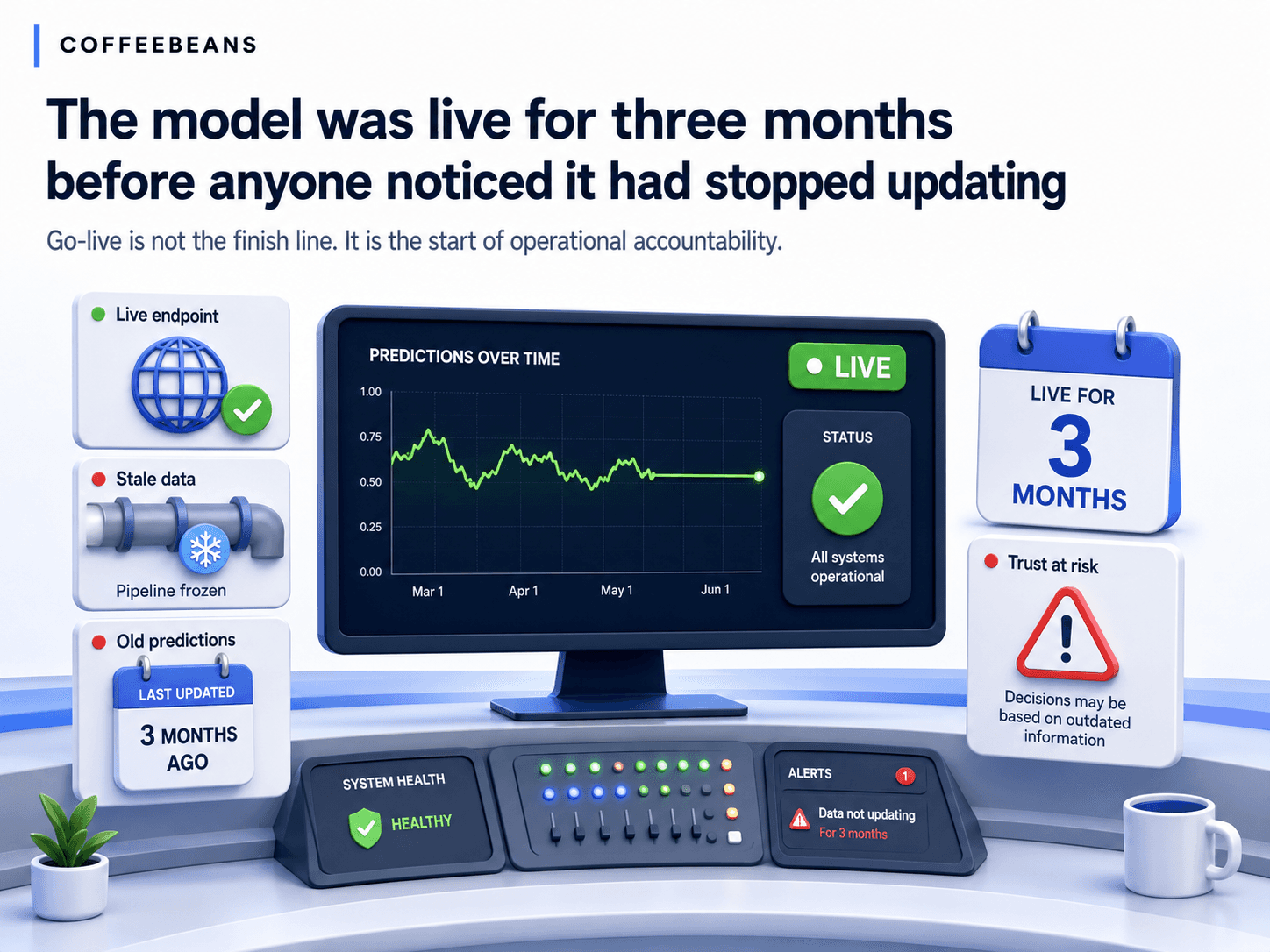
This is the most uncomfortable kind of post-deployment problem to discover, because by the time it surfaces, the damage to operational trust is already done. The operations team does not blame the pipeline. They blame the AI. And the credibility of the entire programme suffers, even though the underlying model was working exactly as designed when it was deployed.
Week 9 explained how to get a predictive model into the control room. Week 10 explains how to keep that deployed model reliable once it is live. Stage 05 of the CoffeeBeans AI Productionization Value Chain is not complete when the model is technically running. It is complete when the model, the pipeline feeding it, the deployment process around it, and the monitoring system above it are all under operational control.
|
What quiet degradation actually looks like
A model can keep producing outputs even when the system around it has started to fail
In our experience working with mining and industrial organisations, the most damaging post-deployment failures rarely produce loud errors. They look like the model continuing to function, in a system that has stopped functioning behind it. A few patterns appear repeatedly:
A sensor feed stops updating. The historian tag the model depends on goes silent after a configuration change. The model continues to produce risk scores using the last value it received, hours or days ago.
A feature pipeline fails and substitutes stale values. The transformation logic encounters an unexpected condition and falls back to the most recent successful calculation. The model still returns predictions. The predictions are based on data the asset has long since moved past.
A model version is updated without proper validation. The data science team replaces the production model with what they believe is an improved version. The new version performs poorly in production conditions that were not covered in testing. The team is unaware which version is currently live.
A scheduled batch job stops running. The orchestrator silently fails on an edge case. The dashboard continues to show predictions, all of which are from the last successful run.
A dashboard shows old predictions. The maintenance team reviews the morning's predictive maintenance recommendations, not realising the underlying scoring has not refreshed since the previous week.
Operations act on outputs without knowing the data is outdated. The most expensive form of this failure. A maintenance intervention is scheduled or skipped on the basis of information that no longer reflects the asset's actual condition.
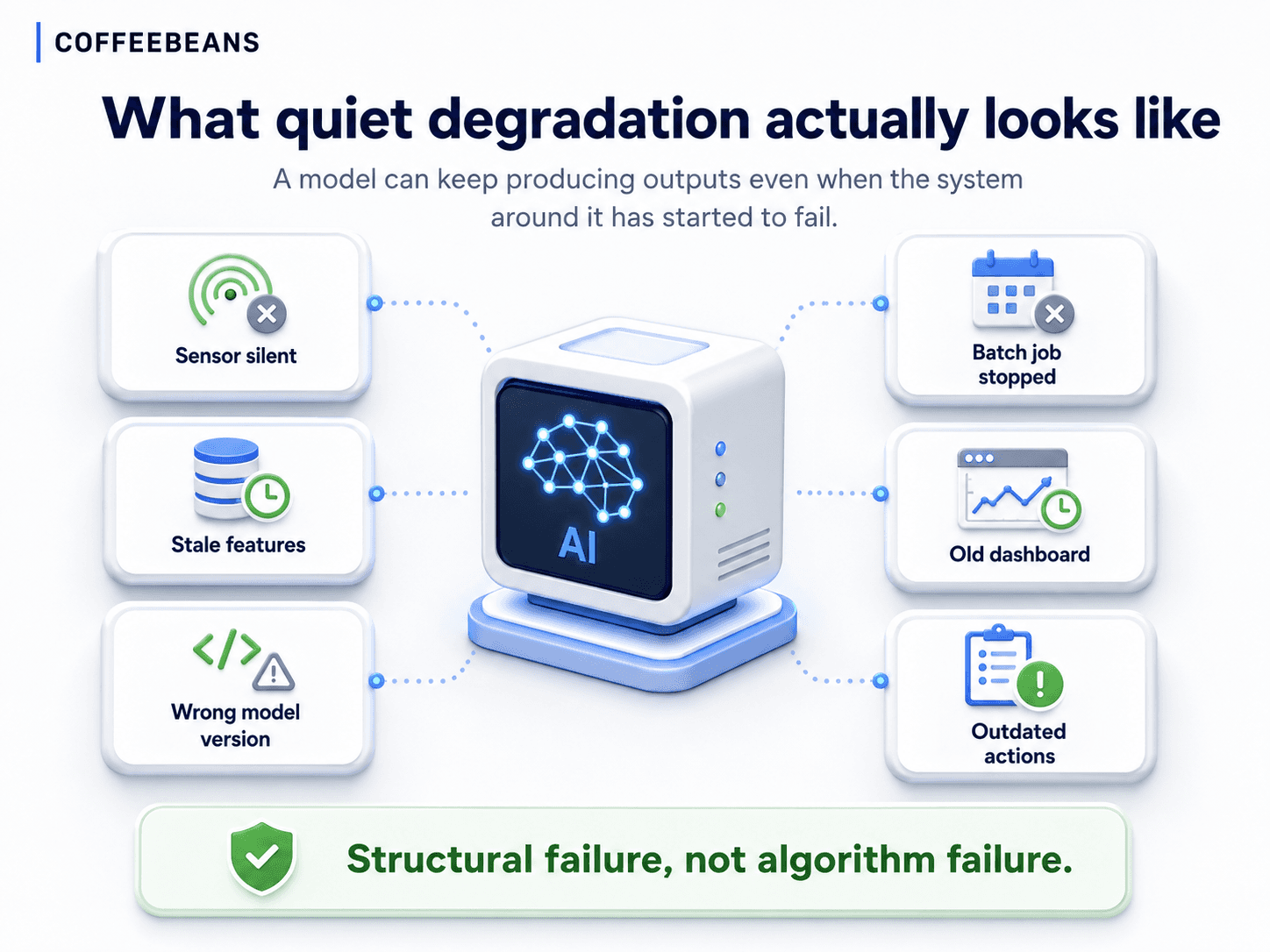
Each of these failures is structural, not algorithmic. None of them is caught by checking whether the model itself is producing predictions, because the model is producing predictions. What has stopped working is the system around the model.
A model can still return predictions even when the system around it has started to fail. That is precisely what makes the failure mode so dangerous.
Why ML deployment is different from software deployment
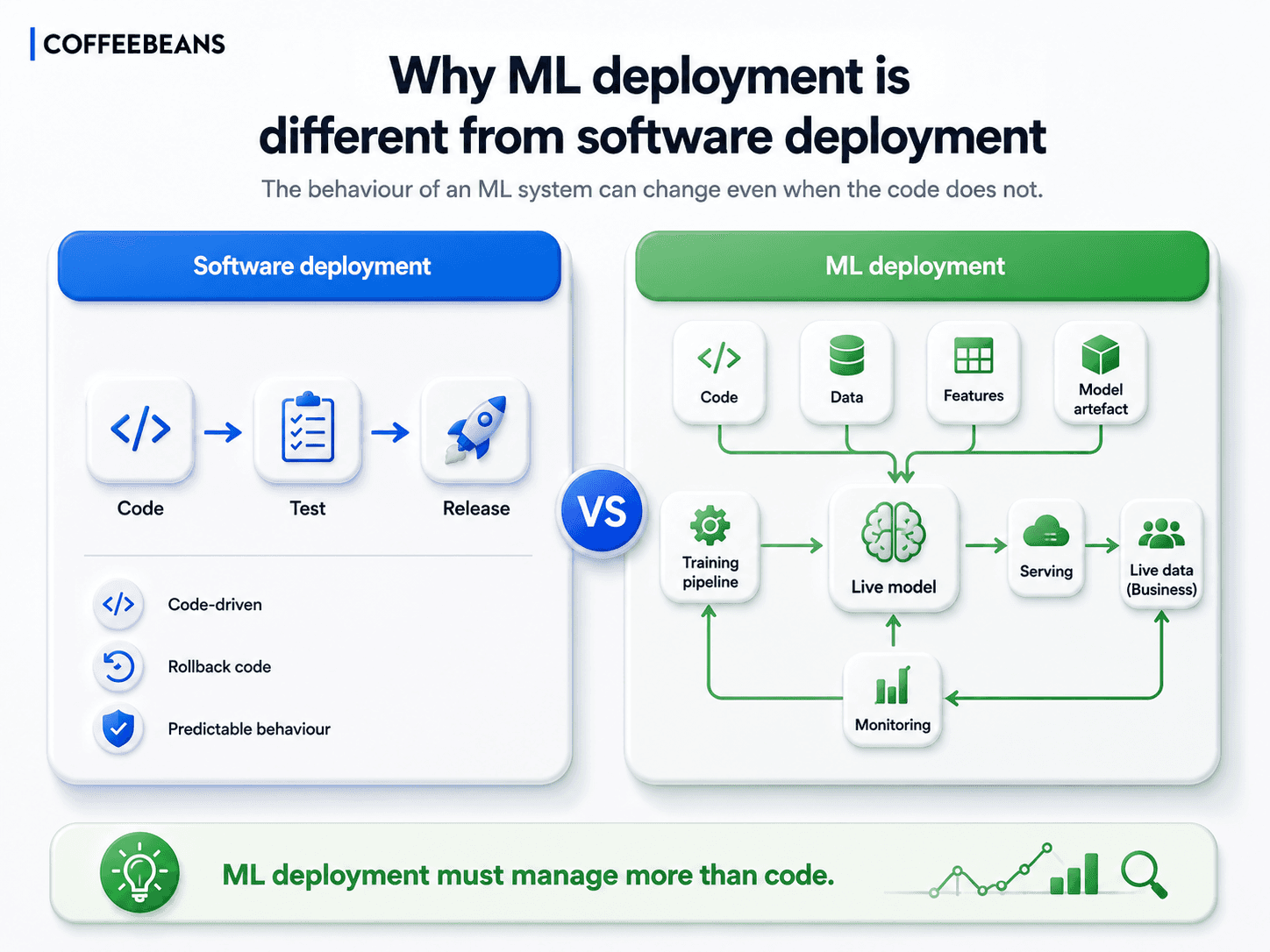
The behaviour of an ML system can change even when the code does not
Traditional software CI/CD primarily manages code changes. A new version of an application is built, tested, and released. The behaviour of the system is determined almost entirely by the code that has been deployed. Roll the code back, and the previous behaviour returns.
ML deployment is structurally different. The behaviour of an ML system depends on the code, but it also depends on the data the model was trained on, the feature definitions used to prepare that data, the model artefact itself, the training pipeline that produced it, the evaluation logic that validated it, the serving infrastructure that runs it, the live data feeding it, and the monitoring signals around it. Any of these can change without the code changing. The system can behave differently tomorrow than it does today, even if nobody has committed a single line of code.
|
What CI/CD for ML should actually include
A discipline that holds the entire production AI system under controlled change
MLOps CI/CD machine learning discipline is the broader practice that turns model deployment from a project milestone into an operational capability. It does not replace software CI/CD. It extends it to cover the artefacts ML systems depend on. In practical terms, an industrial AI CI/CD setup should include the following:
Version-controlled code. Every change to training, feature, and serving code is tracked, reviewed, and traceable.
Versioned datasets or data references. The exact data extract used for training is recoverable months or years later.
Versioned feature logic. Feature transformations are managed through a feature store or equivalent governance layer, with explicit versioning.
Automated tests. Unit tests on transformation logic, integration tests on pipelines, and model validation tests against held-out data.
Model validation checks. Every new candidate model passes a defined performance, bias, and edge-case battery before it can be promoted to production.
Approval workflows and environment promotion. Models move through development, staging, and production environments under documented criteria. Promotion is a controlled event, not a manual file copy.
Model registry. A single source of truth for which model versions exist, which is approved, and which is currently live.
Release notes and audit trail. Every production deployment is documented with what changed, who approved it, and when.
Monitoring hooks. The deployment writes telemetry that the Stage 06 monitoring layer can consume from day one.
Rollback paths. Returning to the previous known-good version is a defined operational action, not a recovery improvisation.
Rollback procedures are a reliability requirement, not a failure plan
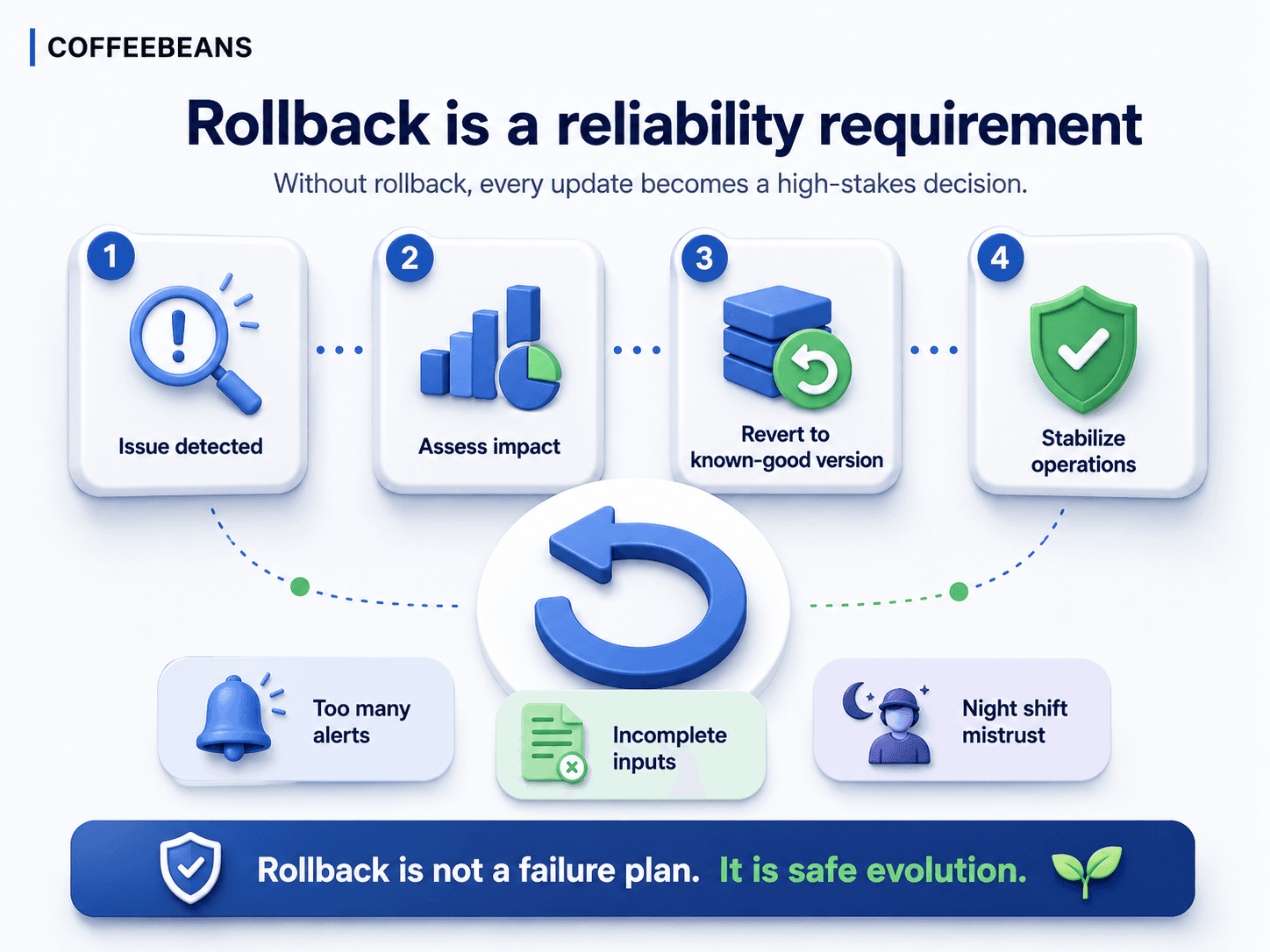
Without rollback, every update becomes a high-stakes decision
Model deployment rollback capability is what allows an organisation to confidently improve a deployed model without the risk of making things worse. The rollback procedure is the structured process that returns the production system to a previous, known-good model version, feature pipeline, or deployment state when the new version behaves incorrectly. In a working mining environment, the situations where this matters are not hypothetical:
A predictive maintenance alert model starts generating five times the number of alerts the maintenance team can review. The new feature engineering logic is over-sensitive. The team needs to revert to the previous version while the issue is diagnosed.
A conveyor risk model receives incomplete input data after a pipeline change, and its outputs become unreliable. The team needs to switch back to the prior serving configuration immediately.
A new model version performs poorly during night shift, producing predictions that operators cannot trust. The team needs to revert before the next shift cycle.
A batch scoring process fails before maintenance planning. The team needs to confirm whether to fall back to the prior schedule or to operate without AI recommendations for the next cycle.
Without rollback, organisations face a difficult choice in each of these moments. They can continue to operate the AI system in a degraded state, accepting the operational risk. They can shut down the AI workflow entirely, losing the value the system was meant to deliver. Or they can attempt an unscheduled, unsupported recovery, which carries its own risks. None of these options is acceptable. A defined rollback procedure removes the need to choose.
Rollback is not a failure plan. It is the discipline that allows production AI to evolve without putting the operation at risk every time it does.
Canary deployment in industrial ML
Release to a limited part of the operation before exposing the whole of it
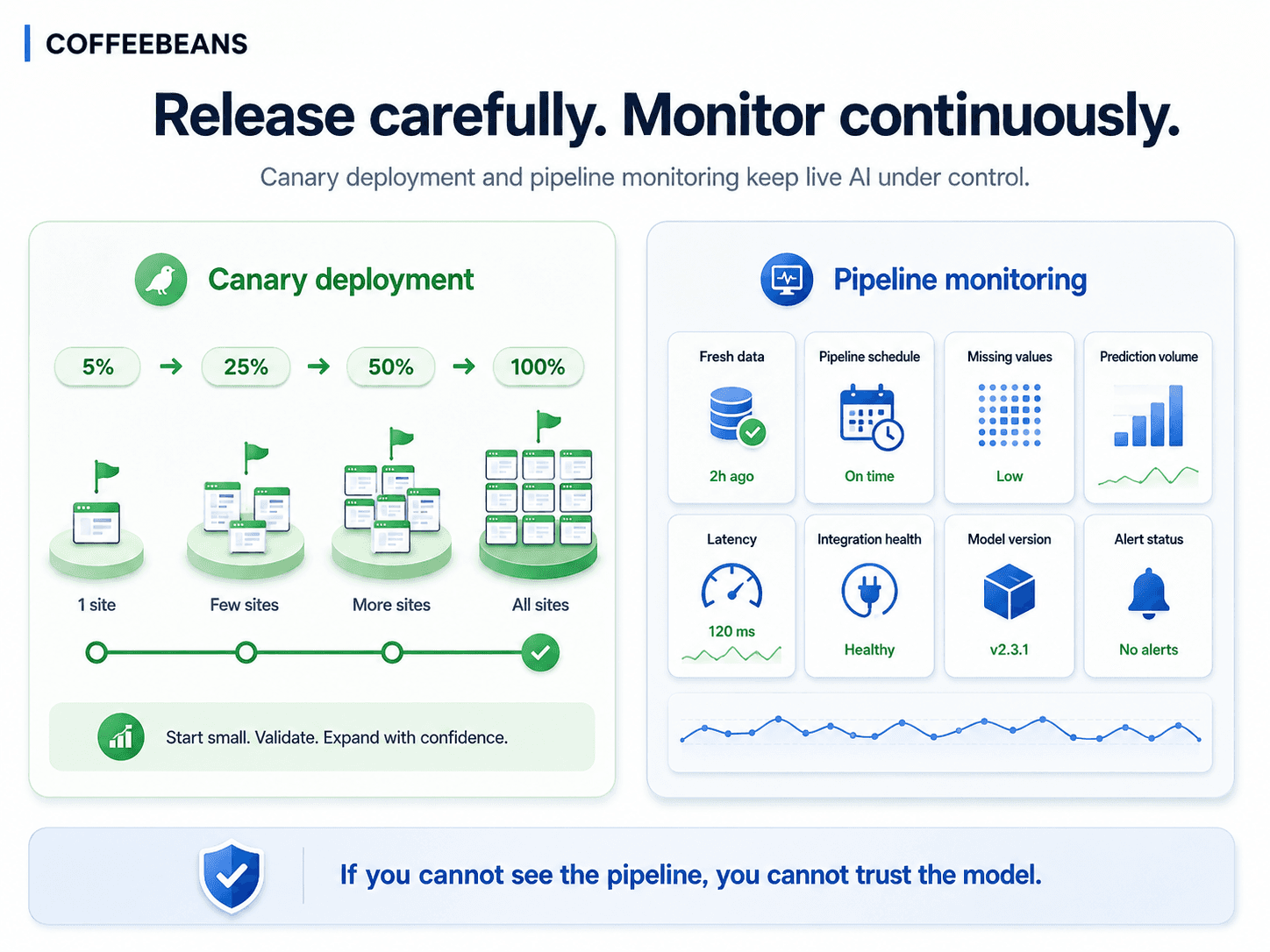
Canary deployment ML practice is the structured release of a new model or pipeline change to a limited part of the operation before extending it more broadly. The name comes from the historical mining practice of using canaries to detect dangerous gases before they affected the broader operation. The principle applied to ML is the same. Release the change in a controlled environment first. Observe how it behaves. Extend only when confidence has been earned.
In an industrial AI context, canary deployment can take several forms:
Deploying to one asset class first. Release the new conveyor downtime model to one belt type or one criticality tier before extending across the full fleet of conveyors.
Deploying to one site before all sites. In multi-site organisations, the new model serves one operation under observation before being rolled out to others.
Deploying to advisory mode before operational action. The new model produces recommendations that are logged and reviewed, but do not yet drive maintenance scheduling, until the team is confident in the new behaviour.
Comparing new and current versions in parallel. Both versions run on the same data. Their outputs are compared. The new version is promoted only when it has demonstrably outperformed the current one.
Canary deployment is not a slowdown. It is the structural discipline that allows new models to be released frequently and with confidence. In industrial environments where the cost of a faulty deployment falls on operations, this discipline is the difference between a programme that can improve over time and one that becomes too risky to update.
|
Pipeline monitoring is part of deployment, not a separate stage
If you cannot see the pipeline, you cannot trust the model
A deployed AI system that cannot be observed is a deployed AI system that will eventually fail silently. Pipeline monitoring is not something added after deployment. It is part of the deployment itself, designed from the start. In an industrial AI context, pipeline monitoring should cover at minimum the following:
What the model output tells you | What pipeline monitoring must also tell you |
The current prediction or alert | Is the model receiving fresh data, or is it scoring on stale inputs? |
The model version that produced it | Is the feature pipeline executing on schedule, or has a step failed? |
The asset or scope the prediction applies to | Are missing values within expected bounds, or is data quality degrading? |
The recommended action | Is prediction volume consistent with normal operation, or has it changed unexpectedly? |
Is latency within target, or has serving infrastructure begun to lag? | |
Is the integration with downstream systems healthy, or have alerts stopped flowing? |
The monitoring layer is where Stage 05 connects to Stage 06 of the productionisation chain. Designed correctly, it gives operations teams the confidence that the AI system is not only producing predictions, but producing predictions that can be trusted. Designed poorly or left until later, it produces the three-month-blind-spot failure pattern that gives this article its title.
The leadership mistake we see repeatedly
Asking 'did the model go live?' instead of 'how will we know if it stops working?'
The most common leadership question after a successful go-live is, did the model go live? The technical answer is yes. The model is running, predictions are flowing, and the dashboard is populated. The question that should follow is different.
What will tell us if the model, the data pipeline, or the deployment process stops working? If the team can answer that question with specific reference to monitoring signals, alert thresholds, rollback procedures, and ownership of response, the deployment is operationally sound. If the team cannot answer it, the deployment is exposed to silent failure from day one, regardless of how well the model itself performs.
How Stage 05 connects to Stage 06
Monitoring begins with deployment design, not after something breaks
Stage 05 of the CoffeeBeans AI Productionization Value Chain is not complete when a model is deployed under CI/CD discipline with rollback and canary capability in place. It is complete when the monitoring infrastructure that Stage 06 will operate is built into the deployment from the start. Logging, telemetry, drift detection thresholds, and pipeline health checks are deployment work, not post-deployment additions.
Stage 06, Model Health and Performance, is the topic of the next two articles in this series. For Stage 05 purposes, the relevant point is that the deployment design determines whether Stage 06 can do its job. A well-designed deployment makes monitoring straightforward. A poorly designed one leaves the team with the same blind spots that allowed the model to be live for three months before anyone noticed it had stopped updating.
How CoffeeBeans helps
Building deployment infrastructure that holds after go-live
CoffeeBeans works with mining and industrial organisations to build MLOps CI/CD machine learning infrastructure that turns model deployment from a project event into an operational capability. Our Stage 05 engagements typically cover the full release discipline: version control across code, data, features, and models; automated testing and validation pipelines; environment promotion workflows from development through staging to production; and the audit trail that governance, compliance, and operations teams need to trust the system.
From that foundation, we engineer the operational reliability layer. Model deployment rollback procedures are designed and tested before go-live, not improvised after a failure. Canary deployment ML patterns are configured for the specific operational structure of the organisation — asset class, site, advisory mode, or parallel run, depending on the use case. Pipeline monitoring is built into the deployment from day one, with explicit telemetry on data freshness, feature availability, prediction volume, model version, latency, and integration health. The objective is straightforward: when an industrial AI model is live, the operations team should know within minutes if the system around it is not working, not within three months.
If your AI stops working, how will you know?
If your industrial AI programme has deployed models that are technically live but operationally invisible, the gap is in the release and monitoring discipline. CoffeeBeans can help your team design the MLOps CI/CD machine learning infrastructure your deployment requires, build the model deployment rollback procedures that production AI cannot operate safely without, and configure the canary deployment ML patterns that allow your AI capability to evolve without putting operations at risk. Talk to our Enterprise AI practice about post-deployment reliability in your operation.
Like What You’re Reading?
Subscribe to our newsletter to get the latest strategies, trends, and expert perspectives.
Similar Reads



Links
Subscribe
Newsletter
Sign up to learn about AI in the business world.
© 2026 CoffeeBeans. All Rights Reserved.