Chemicals: why batch process data breaks most AI pipelines built for continuous operations
AI chemicals manufacturing depends on batch-aware data pipelines. Variable cycle lengths, recipe changes, and end-of-batch quality measurements need a different approach

10
min read

Chemical batch manufacturing needs AI pipelines designed around batches, phases, recipes, and quality outcomes. Continuous-process assumptions rarely survive contact with batch reality. The framework does not change. The data problem does.
Over the last twelve articles in this series, we have argued that industrial AI succeeds because of the discipline that surrounds the model: data readiness, signal creation, train and serve consistency, model building, pre-production validation, deployment governance, and ongoing monitoring. Round 1 used mining as the anchor industry, because mining operations make the data and infrastructure realities of industrial AI especially visible. Round 2 broadens the lens. The framework is the same. The operational context is not.
This week, we begin with chemicals manufacturing, and specifically with batch operations. The Indian chemical sector is now approximately a 220 billion dollar market growing at close to 9 percent CAGR toward 2030, and our own value chain intelligence work has consistently shown two stages of the chemical value chain absorbing the highest AI and data investment intensity: chemical synthesis and reaction processing, and quality control and compliance. Both stages are dominated by batch behaviour in specialty chemicals, agrochemicals, fluorochemicals, and performance chemicals. And both stages expose the limits of AI pipelines designed under continuous-process assumptions.
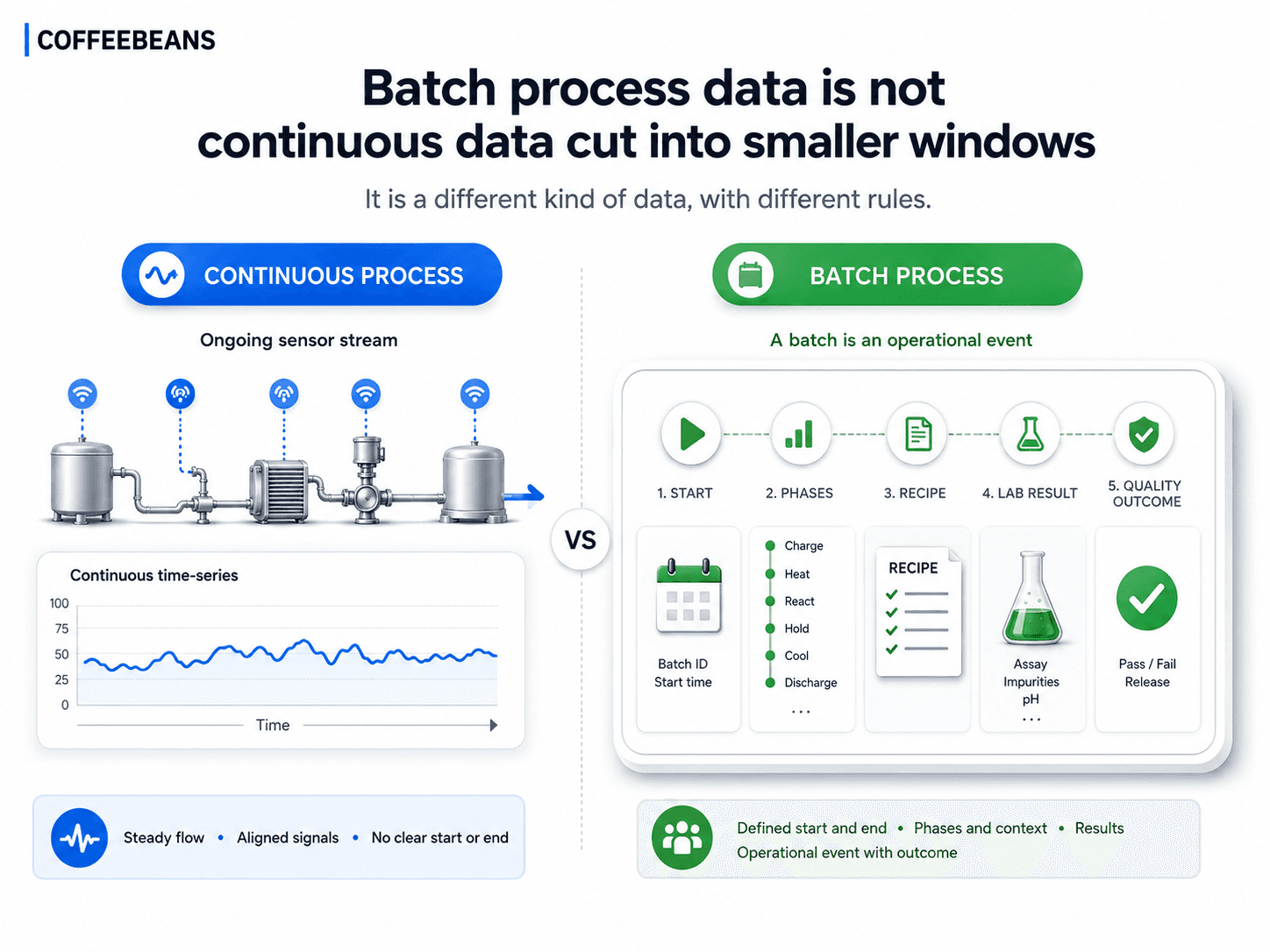
In our experience working with specialty, agrochemical, fluorochemical, and performance chemicals producers, the most common reason industrial AI programmes stall in this sector is not technical sophistication. It is a structural mismatch between the assumptions baked into most AI pipelines, which are usually shaped by continuous-process thinking, and the operational reality of batch manufacturing. A batch is not a slice of a continuous time series. It is an operational event with a beginning, a sequence of phases, a recipe, a product grade, raw material inputs, manual interventions, lab results, and a quality outcome that may only become visible long after the batch is finished.
Most AI pipelines assume stable flow. Batch manufacturing rarely gives you that simplicity.
|
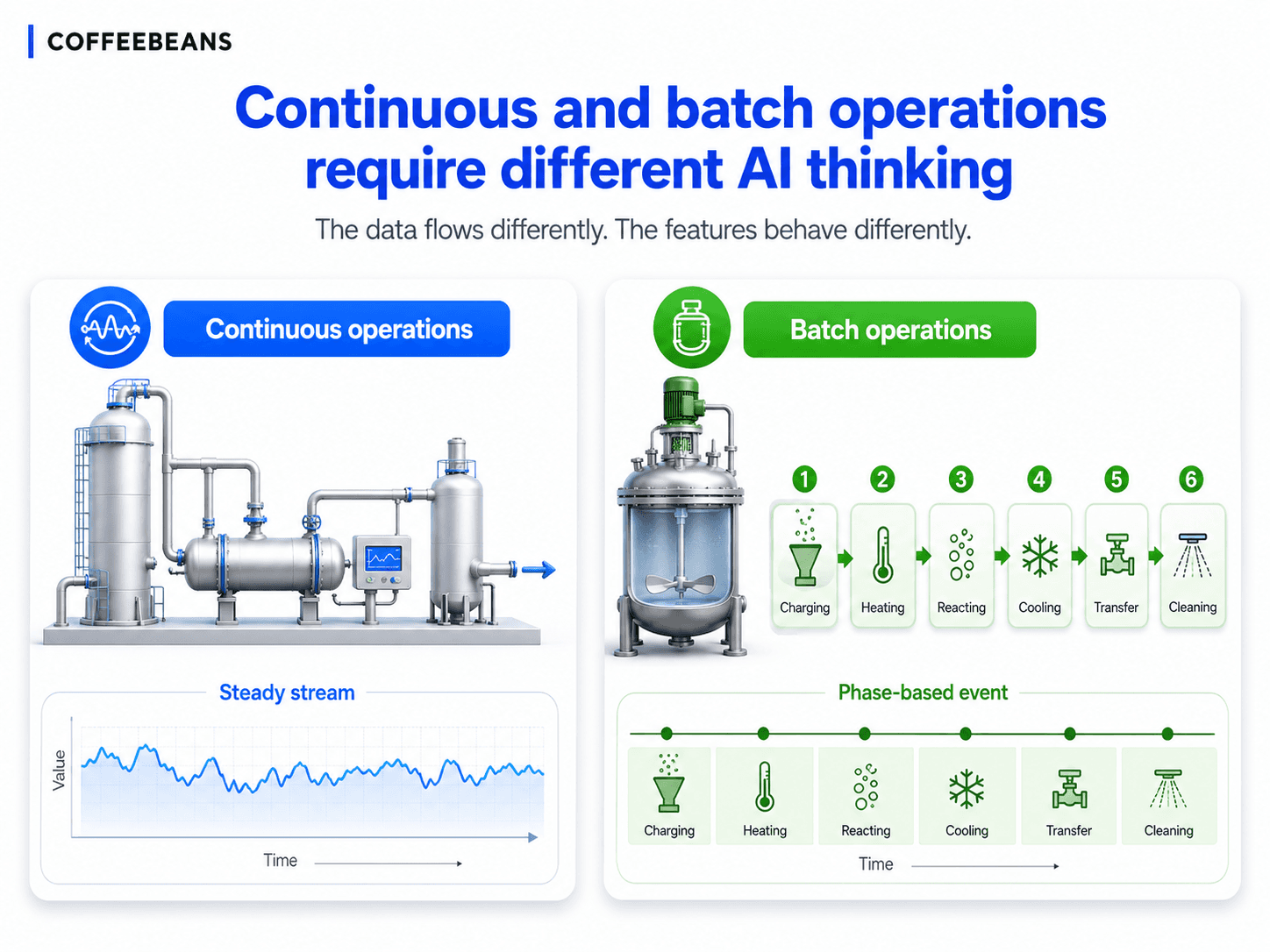
Continuous and batch operations require different AI thinking
The data flows differently. The features behave differently. The model has to respect that.
Continuous operations, including many sections of mining processing, oil and gas refining, and large-scale industrial process plants, generate relatively steady streams of sensor and process data. Variables are monitored continuously. Models can learn from time-aligned signals. The operational rhythm tends to support standard time-series methods, with adjustments for the specific physics of the asset and the conditions of the plant.
Batch operations behave differently in nearly every dimension that matters to a model. Production happens in discrete runs. Each batch has a defined start and finish, a sequence of phases (charging, heating, reacting, cooling, transferring, cleaning), and a recipe that determines what should happen at each step. Different batches may have different durations because the recipe specifies an end condition rather than a fixed time. Different product grades may use different operating envelopes on the same equipment. Quality outcomes may not be known until lab results return, sometimes hours or days after the batch has been released. And the data needed to make sense of any of this lives across the historian, the manufacturing execution system, the laboratory information management system, the quality management system, the ERP, and frequently in operator notes that may or may not be structured.
A batch is not just a time-series segment. It is an operational event with context, and the AI pipeline has to be built around that fact.
Why batch data breaks standard AI pipelines
Variable cycles, recipe changes, phase context, and quality timing all matter
In our experience, the structural challenges that cause continuous-process AI pipelines to fail when applied to chemical batch operations include the following:
Variable cycle lengths. One batch of the same recipe may run 4.2 hours; the next 5.1 hours. Time-aligned methods that assume comparable windows produce confused features.
Different phase durations within a batch. The heating phase may last twenty minutes in one run and forty in another, depending on raw material lot, equipment condition, and operator decisions.
Recipe and product grade changes. The same reactor produces different products on different days. The operating envelope changes with the product, and so does what constitutes normal sensor behaviour. This is especially pronounced in CRAMS and CDMO operations, where the same equipment serves a portfolio of customer molecules.
End-of-batch quality measurements. Quality is often only fully known after laboratory testing. A real-time pipeline that needs the outcome for training or labelling is operating without the most important signal until the lab returns its result.
Lab data delays and structure. Lab results arrive asynchronously, sometimes in different units or formats, and frequently in systems disconnected from the historian.
Equipment changeovers and cleaning cycles. Cleaning between batches alters baseline equipment condition. A model that does not understand changeover events will misread the cleaning data as anomalous operation.
Operator interventions. Manual adjustments are frequent in batch chemistry, and are often the most operationally important events in a batch. If they are not captured as structured data, the model cannot learn from them.
Missing or inconsistent batch identifiers. When batch IDs are not propagated across the historian, MES, LIMS, and ERP, the data cannot be aligned. The entire pipeline degrades to time-based joining, which loses the operational meaning of the batch.
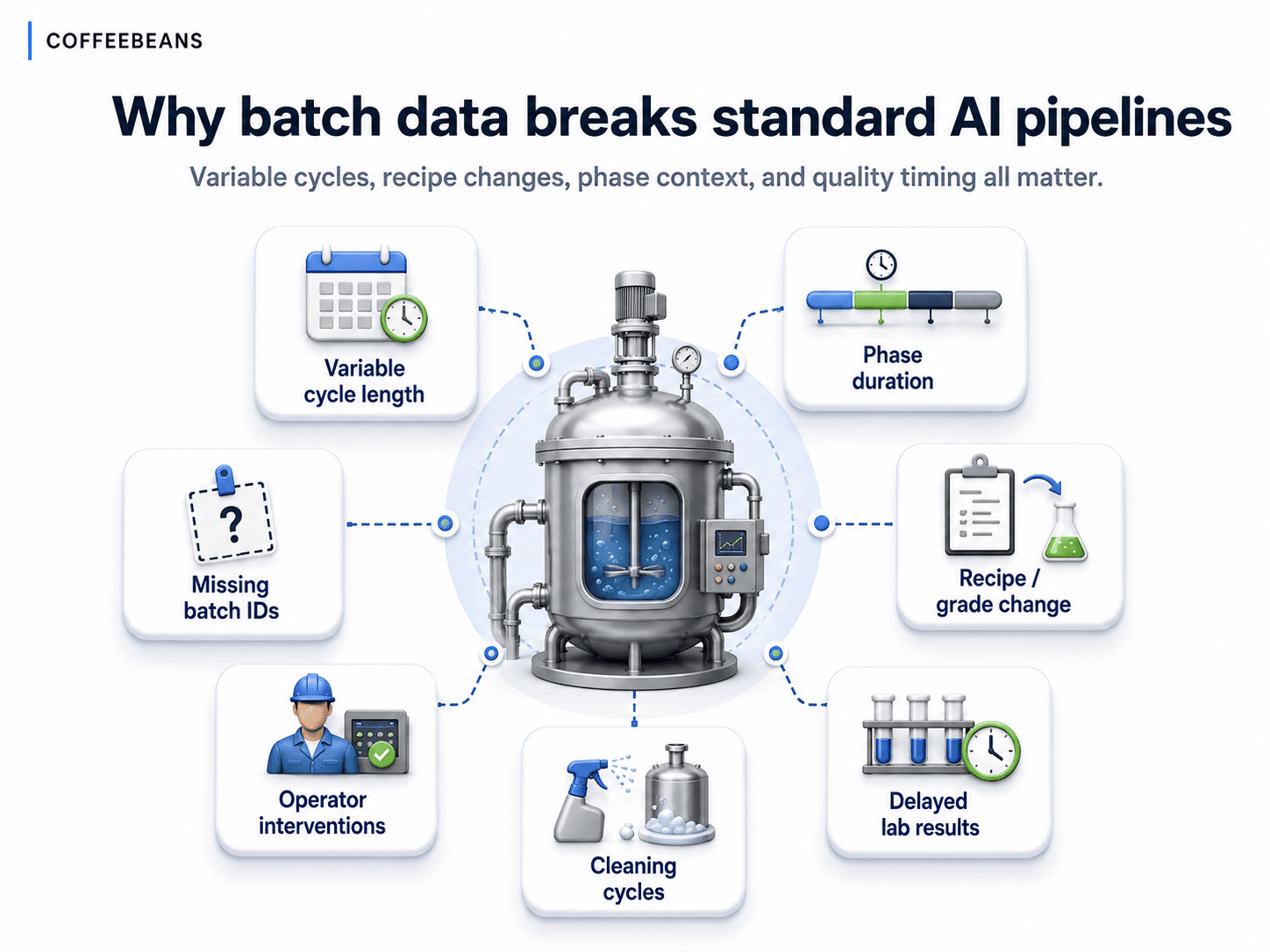
Each of these challenges is solvable. None of them is solved by default. Pipelines designed around continuous-process assumptions do not encode the operational reality of batch chemistry, and trying to retrofit batch awareness onto them is typically more expensive than building the pipeline correctly from the start.
|
Time alignment is harder in batch manufacturing
Comparing one batch to another is not as simple as comparing timestamp to timestamp
Consider a simple example. A model is being built to predict off-spec product on a batch reactor in a specialty chemicals plant. The team has years of historian data, recipe records, and lab results. The temptation is to treat the data as a continuous stream and apply standard time-series methods. The result tends to disappoint, for a structural reason: a temperature profile at minute 30 may mean one thing in a short batch and something entirely different in a long batch. A pressure excursion may be a routine part of the charging phase and a serious warning sign during the reaction phase. A vibration signature may be normal during agitation and abnormal during heating.
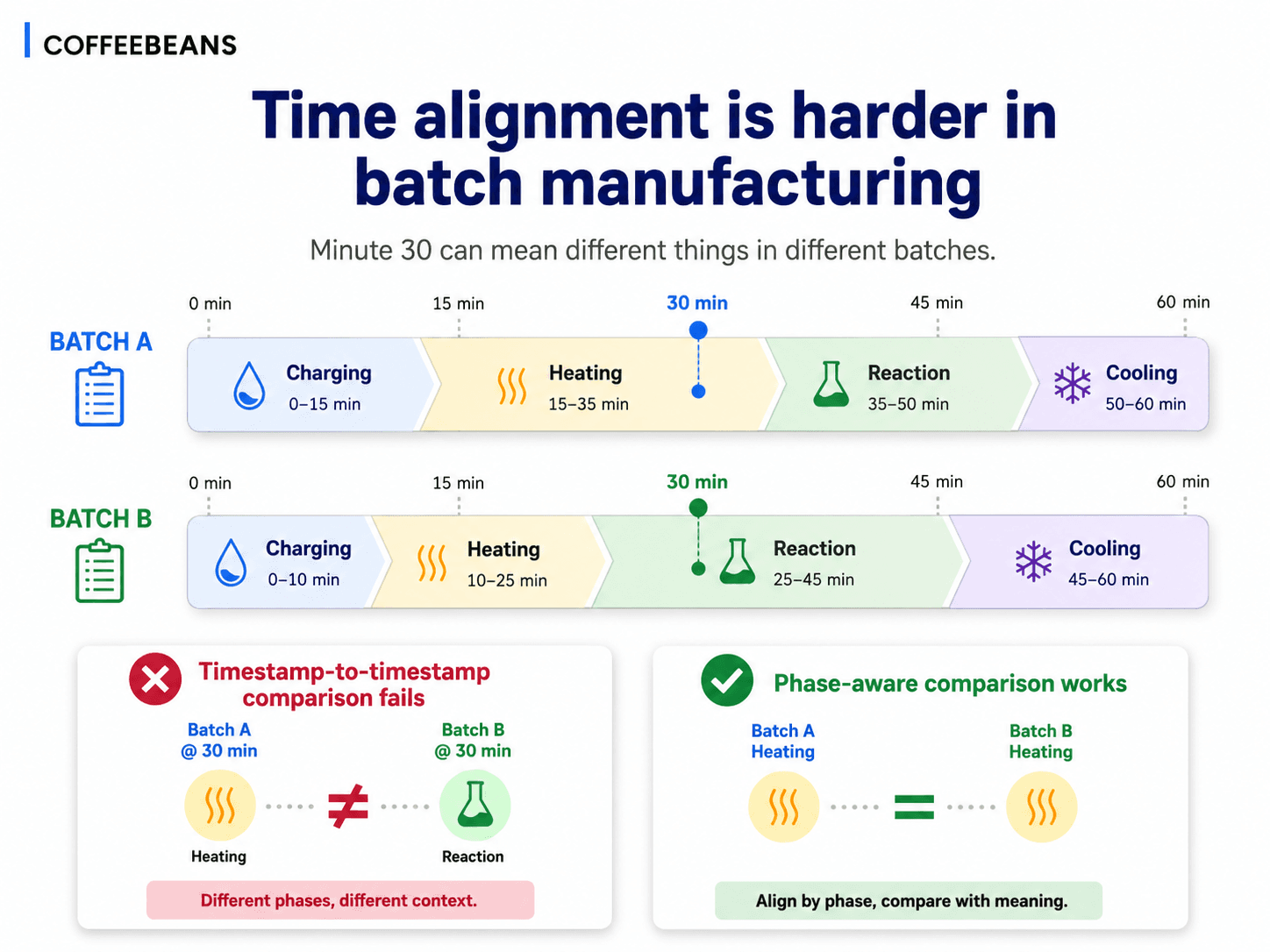
None of this distinction can be recovered by treating time as the only axis. Batch-aware feature engineering normalises time within each phase rather than across the full run. It tags features by phase, recipe, and product grade. It links late-arriving lab results back to the batches that produced them. It distinguishes between operating, cleaning, and changeover states. The work is unglamorous and entirely structural, and it is where the value of batch process machine learning is either created or quietly lost.
What a batch-aware AI pipeline must include
Process context is as important as sensor values
Effective chemical plant AI data pipeline infrastructure for batch manufacturing requires several elements that are unfamiliar to teams whose experience has been built on continuous-process work:
Batch and phase identifiers propagated consistently across historian, MES, LIMS, QMS, and ERP, so that data from different systems can be joined to the same batch event.
Recipe and product grade context as first-class features, not as descriptive metadata. The same equipment behaves differently depending on what it is producing.
Time normalisation within phases so that batches of different durations can be compared meaningfully.
Event alignment between sensor data, manual interventions, equipment changeovers, and cleaning cycles.
Quality outcome linkage connecting lab results back to the specific batches they describe, with handling for the delay between batch completion and result availability.
Operator note integration where free-text notes are systematically structured into features the model can use.
Phase-level feature engineering so that features summarise behaviour within phases, not across arbitrary time windows.
Traceability from batch to prediction so that every model output can be linked back to the batch event that produced it and the quality outcome that followed. This traceability also serves the EHS and regulatory documentation that chemical plants must maintain.
Monitoring decomposed by recipe, grade, equipment, and operating condition, so that drift is detected within meaningful operational segments rather than averaged across the whole plant.
A chemical plant AI data pipeline must understand process context, not only sensor values. Without that context, the model is reading the words and missing the sentence.
The six-stage framework, adapted for chemicals
Same framework, batch-aware implementation
The CoffeeBeans AI Productionization Value Chain applies to chemical manufacturing in exactly the same structural way it applies to mining. What changes is how each stage is implemented. The table below summarises the adaptation.
Stage | What it requires in chemical batch manufacturing |
Stage 01: Data Readiness and Trust | Batch IDs, recipes, phases, raw material lots, lab results, equipment context, and process data must be connected and governed as a single operational record across historian, MES, LIMS, QMS, and ERP. |
Stage 02: Signal Creation and Data Prep | Features are engineered around batch phases and recipe context, not only around timestamps. Time alignment is normalised across batches of different durations. |
Stage 03: Model Building and Experimentation | Labels link batch behaviour to quality outcomes from the lab. Baselines, class imbalance, and experiment tracking are all defined at the batch and recipe level. |
Stage 04: Pre-Production Sign-off | Validation covers edge batches, recipe transitions, off-spec scenarios, and quality risk. Human review involves operations, quality, EHS, and lab leadership. |
Stage 05: Model Deployment and Serving | Outputs fit the production workflow: in-batch advisory in the control room, end-of-batch release support, or quality review. Inference cadence matches the operational decision. |
Stage 06: Model Health and Performance | Drift monitoring is decomposed by recipe, product grade, equipment, raw material lot, and process condition. Retraining triggers reflect batch reality, not calendar. |
This adaptation is not theoretical. The Indian chemical industry value chain heatmap that we maintain places chemical synthesis and reaction processing and quality control and compliance at the highest tier of AI and data investment intensity across the sector, with separation and purification and formulation and blending also at high intensity. Each of those four stages is dominated by batch behaviour in specialty, agrochemical, fluorochemical, and performance chemical contexts. Each of them requires the six-stage productionisation framework to be implemented batch-aware. The categories where margin is most directly at risk, particularly specialty chemicals and CRAMS or CDMO operators, are also the categories where batch discipline most directly determines whether AI delivers value or stalls.
The leadership mistake we see repeatedly
Reusing the continuous-process AI pipeline because it is already there
The most common leadership question in chemicals AI conversations is, can we use our existing AI pipeline for batch data? The technical answer is usually yes, in the sense that the infrastructure can ingest batch data. The operational answer is more honest. The pipeline can ingest the data; it cannot interpret it. A continuous-process pipeline does not understand batches, phases, recipes, or end-of-batch quality. Forcing batch data through it tends to produce models that look reasonable in training and disappoint in production.
The better question, every time, is this: does the pipeline understand how batches, phases, recipes, and quality outcomes actually behave? If the answer is no, the right response is to build the batch-aware layer, not to retrofit it onto a pipeline that was never designed for the problem.
Why this matters for chemicals leadership
Batch-aware AI is the foundation for yield, quality, energy, and ESG outcomes
For leaders in chemicals manufacturing, AI chemicals manufacturing investments deliver value when the AI pipeline respects the structure of batch production. The business outcomes that depend on this discipline include better batch quality prediction, reduction in off-spec production, faster root cause analysis when a batch goes wrong, improvements in yield, more reliable process optimisation, better energy and material efficiency in line with decarbonisation commitments, stronger quality and EHS governance with traceable model outputs, and an AI capability that can scale beyond initial pilots into a sustained operational system. Industry research consistently associates well-implemented AI-driven process optimisation with cost reductions in the range of 5 to 15 percent and reductions in unplanned downtime of 20 to 30 percent, but these outcomes are achieved only where the data pipeline is built for the operational reality of the plant.
In our experience, the chemicals organisations that move AI from pilot to production reliably are those that recognise batch operations as a structurally different data problem and invest in the pipeline accordingly. The organisations that try to share infrastructure designed for continuous processes typically generate promising proofs of concept that fail to translate into operational value.
How CoffeeBeans helps
Building batch-aware AI pipelines for chemical manufacturing
CoffeeBeans works with chemicals and specialty-chemicals manufacturers to apply the AI Productionization Value Chain in batch-aware form. Our AI chemicals manufacturing engagements typically begin with the data foundation: identifying the batch event as the central organising unit, propagating batch and phase identifiers across plant, lab, and enterprise systems, and integrating MES, LIMS, QMS, and historian data into a single governed view of each batch.
From there, we build the batch process machine learning layer on top. Features are engineered around phases and recipes. Models are trained against batch-level quality outcomes with appropriate handling for late-arriving lab data. Pre-production validation is structured around recipe transitions, off-spec scenarios, and edge batches. Deployment fits the production workflow, whether that is in-batch advisory, end-of-batch release support, or quality review. And the chemical plant AI data pipeline is monitored at the level of recipe, grade, equipment, raw material lot, and operating condition, so that drift is detected within meaningful operational segments rather than averaged across the plant.
Is your AI pipeline reading sensors, or understanding batches?
If your chemical operation has rich plant and lab data but AI initiatives that struggle to translate into operational value, the gap is almost always in the batch-awareness of the data pipeline. CoffeeBeans can help your team design the AI chemicals manufacturing foundation, build the batch process machine learning layer, and operationalise the chemical plant AI data pipeline your production workflow actually needs. Talk to our Enterprise AI practice about batch-aware AI in your operation.
Like What You’re Reading?
Subscribe to our newsletter to get the latest strategies, trends, and expert perspectives.
Similar Reads



Links
Subscribe
Newsletter
Sign up to learn about AI in the business world.
© 2026 CoffeeBeans. All Rights Reserved.